Retrieval Breaks at the Boundaries
Six places a knowledge base goes wrong between a document and the model's answer, how FastAIAgent holds each one, and a proof you can run for every claim.
Requires FastAIAgent 1.88.0+ · Download this page as a PDF
FastAIAgent already lets you see retrieval: every search is a retrieval.<kb> span with the query, the backend, the ids that came back and how long it took, and the Local UI's Knowledge Bases browser shows which agents hit which KB (see Knowledge Base).
Seeing what was retrieved is not the same as trusting it. A knowledge base sits between your documents and the model's answer, so it has to hold wherever two things meet:
- a document and the chunks that stand for it;
- the text and the vector that stands for it;
- what a question means and the words it uses;
- the knowledge base and the model;
- one process and the next;
- one laptop and a fleet, or the plane.
Those six boundaries are where retrieval goes wrong.
This page explains how FastAIAgent's knowledge base works, one boundary at a time. Each section has a diagram, the rule the SDK follows, a proof, and the code: the SDK source that implements the rule and the script that proves it. The proofs are in examples/kb/proofs/ and run against the published SDK: real FAISS, Chroma and Qdrant, the local FastEmbed model, and for one section a real model. The offline ones run in CI, so what this page quotes can't drift from what the SDK does. Every output and number below came out of one of those runs. Writing them turned up three defects in 1.87.0, all fixed in 1.88.0; where a section's behaviour changed, it says so.
First: a knowledge base is three stores behind one interface
"Search" is three stores, a chunker and an embedder, and the only one of them that is the source of truth is the plainest.
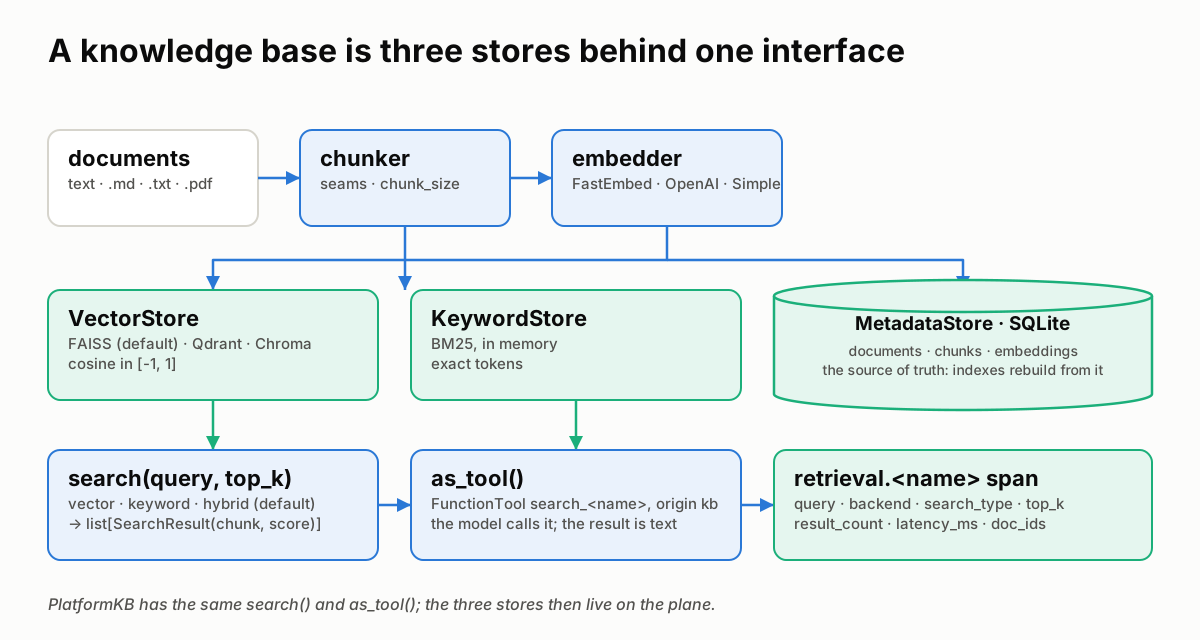 Documents become chunks, chunks become vectors. Vectors go to FAISS, tokens to BM25, and everything, vectors included, to SQLite, which the other two are rebuilt from. One
 search() sits on top; as_tool() hands it to the model.
- The chunker splits a document at its seams and keeps the source, index and character offsets on every chunk.
- The embedder turns each chunk, and later each query, into a vector. It is chosen once per KB and is part of the index.
- The
VectorStoreholds the vectors and answers by cosine: FAISS in-process by default, Qdrant or Chroma by swapping one argument. - The
KeywordStoreis BM25 over the tokens, in memory. It finds exact terms the vector side is blind to. - The
MetadataStoreis SQLite on disk: documents, chunks and their vectors. It is the source of truth; the other two stores are rebuilt from it on open. search()runs vector, keyword or hybrid (the default) and returnsSearchResult(chunk, score).as_tool()wraps it as a tool the model calls, and every search leaves aretrieval.<kb>span.
You declare all of it on one object:
kb = LocalKB(name="support-kb")                 # FAISS + BM25 + SQLite under .fastaiagent/kb/support-kb/
kb.add("docs/")                                  # .md, .txt, .pdf — chunked, embedded, stored
kb.search("ERR-4012", top_k=3)                   # hybrid: meaning and exact tokens
agent = Agent(name="support-bot", llm=llm, tools=[kb.as_tool()])   # the model decides when to search
The rest of this page is what that object has to get right.
Code: LocalKB is kb/local.py; the three store contracts are kb/protocols.py; the defaults are under kb/backends/. The RAG agent end to end is examples/06_rag_agent.py.
1 · Between a document and its chunks: the overlap carries a rule across the seam
A vector stands for a span of text, and a whole document averages out to nothing in particular. So documents are cut into chunks, and where they are cut decides what can be found.
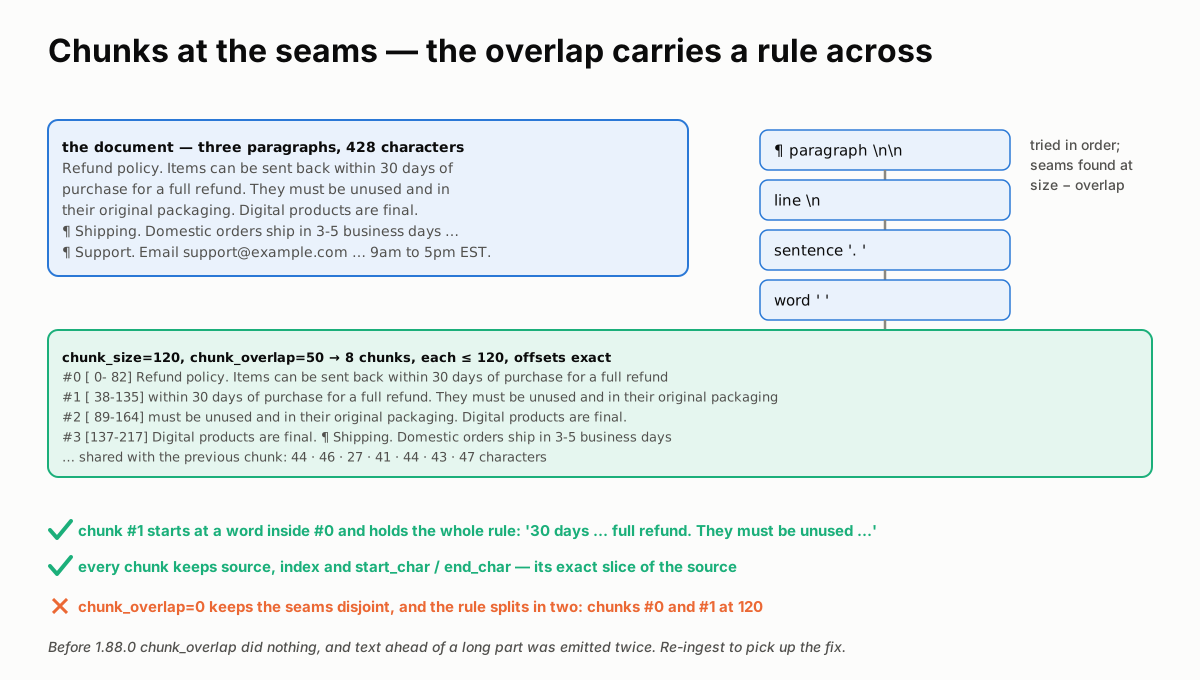 The splitter cuts at the seams, then gives every chunk after the first the tail of the text before it. Each chunk still fits in
 chunk_size and points at its exact slice of the source.
The rules:
- The splitter is recursive. It tries paragraph breaks, then lines, then sentences, then words, and merges the pieces so a chunk ends at the coarsest seam that fits.
- Neighbours overlap. Every chunk after the first starts with up to
chunk_overlapcharacters (50 by default) of the text before it, cut at a word boundary, so a rule that straddles a seam is whole in at least one chunk. To keep the bound, the seams are found atchunk_size − chunk_overlap; the overlap is capped at half ofchunk_size, andchunk_overlap=0keeps the seams disjoint. - Every chunk fits and keeps its provenance: at most
chunk_sizecharacters, itssource, itsindex, andstart_char/end_charthat are its exact slice of the source. - Each span is indexed once. A short piece that its neighbour's overlap swallows whole is dropped rather than indexed twice.
Proof 1 chunks a three-paragraph policy at 512, then at 120 without and with overlap, and measures what neighbours share:
chunk_size=512, overlap=50 → 1 chunk(s)
  #0 [  0-428] 'Refund policy. Items can be sent back within 30 days of purcha'…

chunk_size=120, overlap=0 → 5 chunk(s)
  #0 [  0- 82] 'Refund policy. Items can be sent back within 30 days of purcha'…
  #1 [ 84-164] 'They must be unused and in their original packaging. Digital p'…
  …
  characters shared between neighbours: [-2, -2, -2, -2]

chunk_size=120, overlap=50 → 8 chunk(s)
  #0 [  0- 82] 'Refund policy. Items can be sent back within 30 days of purcha'…
  #1 [ 38-135] 'within 30 days of purchase for a full refund. They must be unu'…
  #2 [ 89-164] 'must be unused and in their original packaging. Digital produc'…
  #3 [137-217] 'Digital products are final.\n\nShipping. Domestic orders ship in'…
  …
  characters shared between neighbours: [44, 46, 27, 41, 44, 43, 47]
  metadata on every chunk: {'source': 'policy.md'}

overlap=0: '30 days … full refund' + 'unused … original packaging' together in chunk(s) []
overlap=50: '30 days … full refund' + 'unused … original packaging' together in chunk(s) [1]
offsets exact: True · every chunk ≤ 120: True
Without overlap the refund rule is split at a sentence seam, and a query that needs both halves gets one. With it, chunk 1 begins mid-sentence at a word, carries the whole rule, and still fits in 120 characters.
Changed in 1.88.0
Until 1.88.0 chunk_overlap was accepted and did nothing: neighbours shared −2 characters, the seam itself. The same function had a second bug: when a part was longer than chunk_size, the text before it was emitted again later, glued to an unrelated paragraph. Both are fixed; an index built before 1.88.0 keeps its old chunks until you re-ingest it.
Code: chunk_text and _recursive_split in kb/chunking.py; PDF pages become one Document each in kb/document.py. The proof is proof_1_chunks.py; tests/test_kb_chunk_overlap.py pins the bound, the offsets and the overlap.
2 · Between text and vector: the embedder is part of the index
A vector means nothing on its own; it means something next to vectors made the same way. That makes the embedder a part of the index, and its quality the ceiling of what retrieval can find.
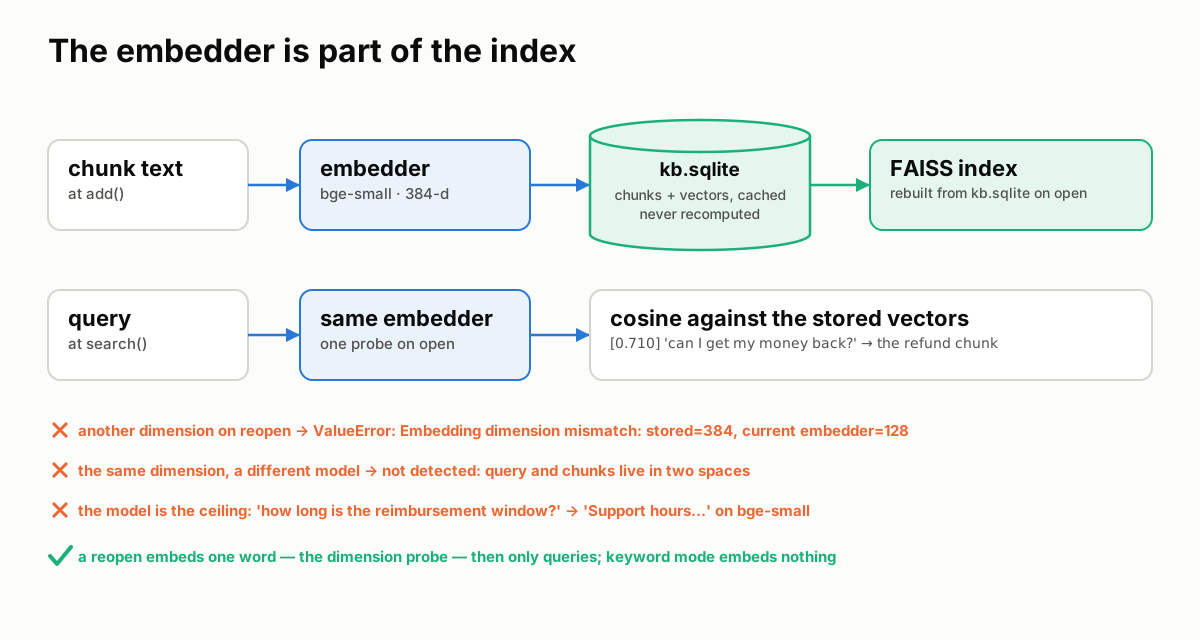 Chunks and queries go through the same embedder. Vectors are cached in SQLite, so a reopen embeds one probe word and nothing else. A different embedder on the same index is refused only if its dimension differs.
The rules:
- The query is embedded the same way as the chunks and scored by cosine against them.
- Vectors are cached in SQLite. A reopen loads them and embeds exactly one word,
test, to check the dimension. Keyword mode never builds an embedder at all. - A different dimension on reopen is refused with
ValueError: Embedding dimension mismatch. A different model of the same dimension is not detected: the query and the chunks then live in two spaces, and nothing says so. - The embedder is auto-selected: FastEmbed if installed, else OpenAI if a key is set, else a character-count fallback that has no notion of meaning.
- The model is the ceiling. A small local model finds some paraphrases and misses others. Hybrid search and an eval are how you find out which.
Proof 2 runs the same two queries through the local 384-dimension FastEmbed model and the fallback embedder, then reopens the index:
── two queries, two embedders
FastEmbed (bge-small, 384-d)   'can I get my money back?'               → [0.710] Items can be sent back within 30 days of pur…
FastEmbed (bge-small, 384-d)   'how long is the reimbursement window?'  → [0.657] Support hours are Monday to Friday, 9am to 5…
SimpleEmbedder (char counts)   'can I get my money back?'               → [0.826] Items can be sent back within 30 days of pur…
SimpleEmbedder (char counts)   'how long is the reimbursement window?'  → [0.803] Error code ERR-4012 means the payment gatewa…

── the embedder is part of the index
indexing 4 documents embedded 4 texts
reopen with another embedder → Embedding dimension mismatch: stored=384, current embedder=128. Use the same embedder that created this KB.
reopen with the same embedder → 4 chunks back, 1 text embedded (a one-word dimension probe)
one search                    → 2 texts embedded in total: the probe and the query; [0.700] Items can be sent back within 30 days of…
The first query shares no word with the refund chunk and the local model found it anyway. The second asks about a "window" and the model reached for "hours". The fallback embedder got one right by luck of character counts. A score is only as meaningful as the model behind it, and nothing in the KB will tell you the second query missed; section 4 is where you find out.
Code: the three embedders and get_default_embedder in kb/embedding.py; the dimension probe and the cache replay are _load_from_metadata in kb/local.py; the cached vectors are kb/backends/sqlite.py. The proof is proof_2_embedder.py.
3 · Between meaning and words: vector, keyword, and how hybrid fuses them
A question has a meaning and it has words, and the two matchers see one each. Hybrid, the default, runs both, and the way it combines them changes what the number means.
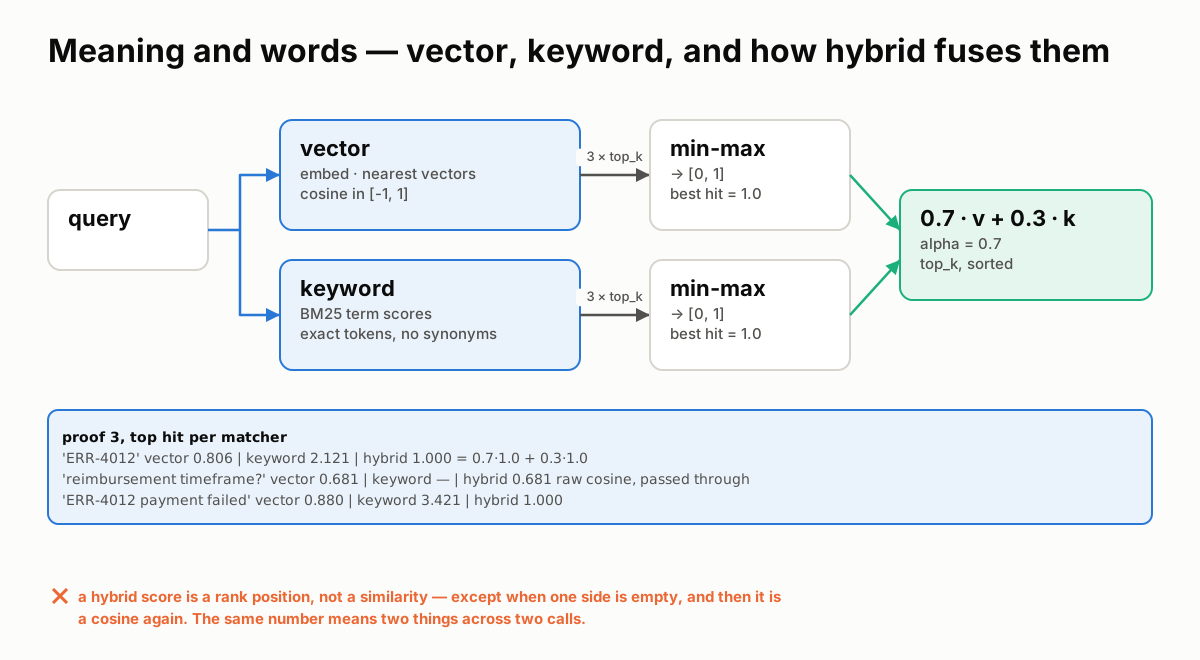 Each side over-fetches, each list is min-max normalized so the two scales can be added, and the fused score is
 0.7 · vector + 0.3 · keyword. When one side is empty the other passes through untouched.
The rules:
- Vector scores are cosines in
[-1, 1], on every backend. Good at meaning, blind to an exact code. - Keyword scores are BM25 over
\w+tokens, lowercased, no stopwords, no stemming. Good at an exact code, blind to a paraphrase. - Hybrid fetches
3 × top_kfrom each side, min-max normalizes each list to[0, 1], and fuses per chunk asalpha · vector + (1 − alpha) · keywordwithalpha = 0.7. The best vector hit is pinned to1.0whatever its cosine was. - When one side returns nothing, hybrid hands the other side back unnormalized. A query with no lexical overlap returns raw cosines, the same numbers
search_type="vector"gives.
Proof 3 sends three queries through all three modes over the same five chunks:
── an exact code: 'ERR-4012'
  vector   [0.806] Error code ERR-4012 means the paym… | [0.701] Error code ERR-5001 means authenti…
  keyword  [2.121] Error code ERR-4012 means the paym… | [0.916] Error code ERR-5001 means authenti…
  hybrid   [1.000] Error code ERR-4012 means the paym… | [0.511] Error code ERR-5001 means authenti…
── meaning, no shared words: 'reimbursement timeframe?'
  vector   [0.681] Support hours are Monday to Friday… | [0.669] Items can be sent back within 30 d…
  keyword  (nothing)
  hybrid   [0.681] Support hours are Monday to Friday… | [0.669] Items can be sent back within 30 d…
── both at once: 'ERR-4012 payment failed'
  vector   [0.880] Error code ERR-4012 means the paym… | [0.698] Error code ERR-5001 means authenti…
  keyword  [3.421] Error code ERR-4012 means the paym… | [2.367] Error code ERR-5001 means authenti…
  hybrid   [1.000] Error code ERR-4012 means the paym… | [0.409] Error code ERR-5001 means authenti…

── hybrid with an empty keyword side is the vector result, unnormalized
  identical: True
── hybrid with both sides: alpha · 1.0 pins the best vector hit
  top hybrid score 1.000 = 0.7 × 1.0 (vector) + 0.3 × 1.0 (keyword) when one chunk tops both
Read the second query: the keyword side found nothing, so hybrid returned the vector scores as they were, 0.681 and 0.669, and the first hit is the wrong one by 0.012. Read the first: the same chunk topped both sides, so its hybrid score is exactly 1.000. A hybrid score is a rank position, not a similarity, except when one side is empty, and then it is a cosine again. Don't compare the number across two calls, and don't threshold on it.
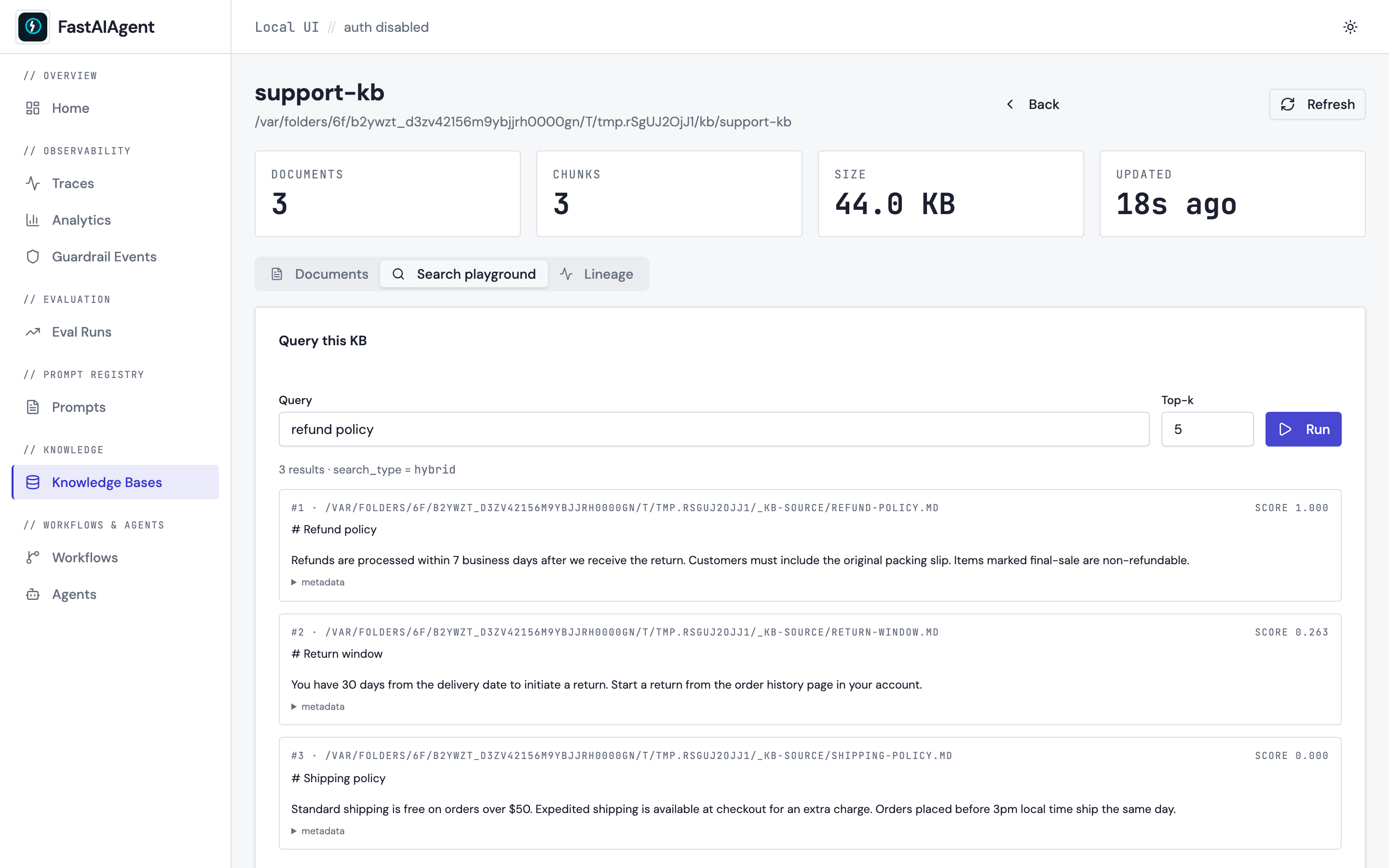 The same arithmetic in the Local UI's search playground: three chunks, hybrid, and the min-max artefact in plain sight: the best hit is
 1.000, the worst is 0.000.
Code: _hybrid_search and _normalize in kb/local.py; the cosine index is FaissIndex in kb/search.py; the tokenizer is kb/bm25.py. The proof is proof_3_matchers.py; the score contract across backends is tests/test_kb_score_semantics_sweep.py.
4 · Between the knowledge base and the model: retrieval is a tool call
A KB does not stuff text into the prompt. The model asks for it, in its own words, and what it gets back is text with a number in front of it.
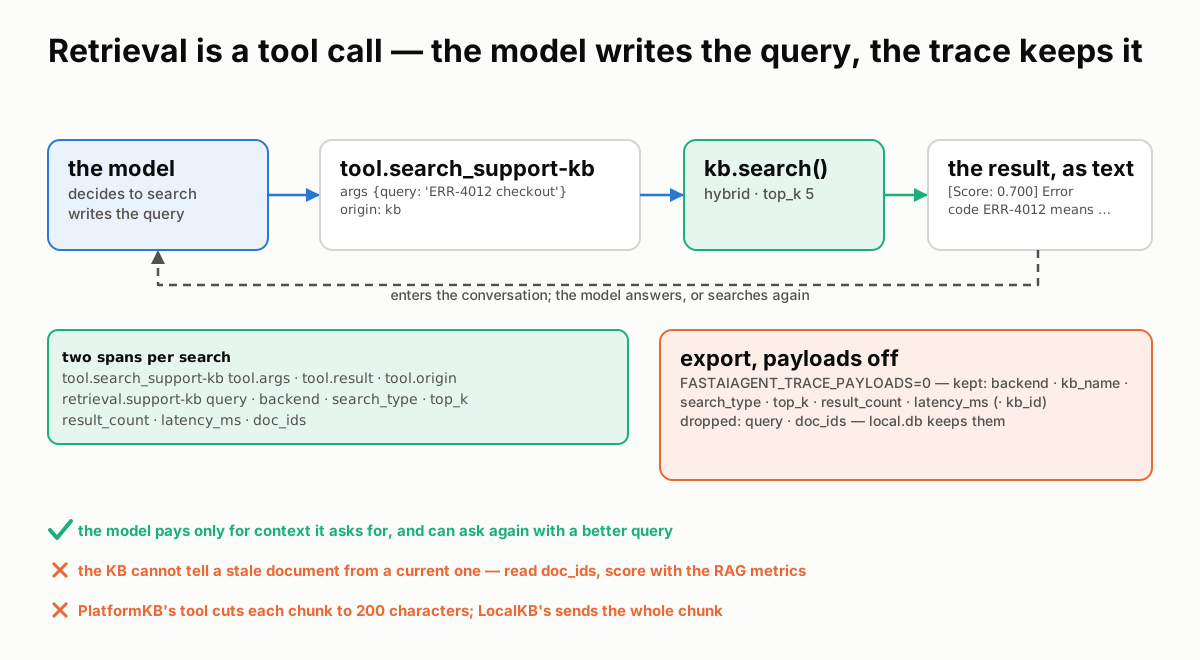 The model writes the query, not the user. The tool returns
 [Score: …] text. Two spans record it, and the export policy decides which of their keys leave the machine.
The rules:
as_tool()is an ordinaryFunctionToolnamedsearch_<kb>withorigin="kb". The model decides when to call it and what to ask; it can call it again with a better query, and it pays only for the context it asked for.- The result is text: each hit as
[Score: 0.700] <chunk>, joined by blank lines.LocalKBsends whole chunks;PlatformKBcuts each to 200 characters. - Two spans per search.
tool.search_<kb>carries the arguments and the result;retrieval.<kb>carries the query, backend, search type,top_k, result count, latency and the ids that came back. - Local capture is full fidelity; the export policy filters. With
FASTAIAGENT_TRACE_PAYLOADS=0the query anddoc_idsare dropped on the way out and the structural keys stay. APlatformKB'skb_idstays too: it is a routing key, not payload. - The KB cannot tell a stale document from a current one. A perfectly retrieved out-of-date policy produces a confident, wrong answer with every model metric green.
doc_idsis where you see it; the RAG metrics are how you score it.
Proof 4 gives a support agent on gpt-4.1-mini the tool and asks about an error code:
── the tool the model sees
name='search_support-kb' origin='kb' description="Search the 'support-kb' knowledge base"

── what happened, from the spans
tool.search_support-kb: tool.name='search_support-kb'
tool.search_support-kb: tool.origin='kb'
tool.search_support-kb: tool.args='{"query": "ERR-4012 checkout"}'
tool.search_support-kb: tool.result='[Score: 0.700] Error code ERR-4012 means the payment gateway timed out. Retry after 30 seconds, then contact support wit'…
retrieval span: {"kb_name": "support-kb", "backend": "faiss", "top_k": 5, "search_type": "hybrid", "query": "ERR-4012 checkout", "latency_ms": 8, "result_count": 3, "doc_ids": "[\"a0516448-…\", \"8fdb5101-…\", \"e62aff41-…\"]"}
answer: The error code ERR-4012 means the payment gateway timed out. You should retry the checkout after 30 seconds. If the problem persists, contact support with the t…

── the export policy, with FASTAIAGENT_TRACE_PAYLOADS=0
kept   : ['retrieval.backend', 'retrieval.kb_name', 'retrieval.latency_ms', 'retrieval.result_count', 'retrieval.search_type', 'retrieval.top_k']
dropped: ['retrieval.doc_ids', 'retrieval.query']
The user asked "My checkout shows ERR-4012. What do I do?"; the model searched for ERR-4012 checkout. That is the query the KB scored, and it is the query in the trace. The Knowledge Bases browser reads those spans:
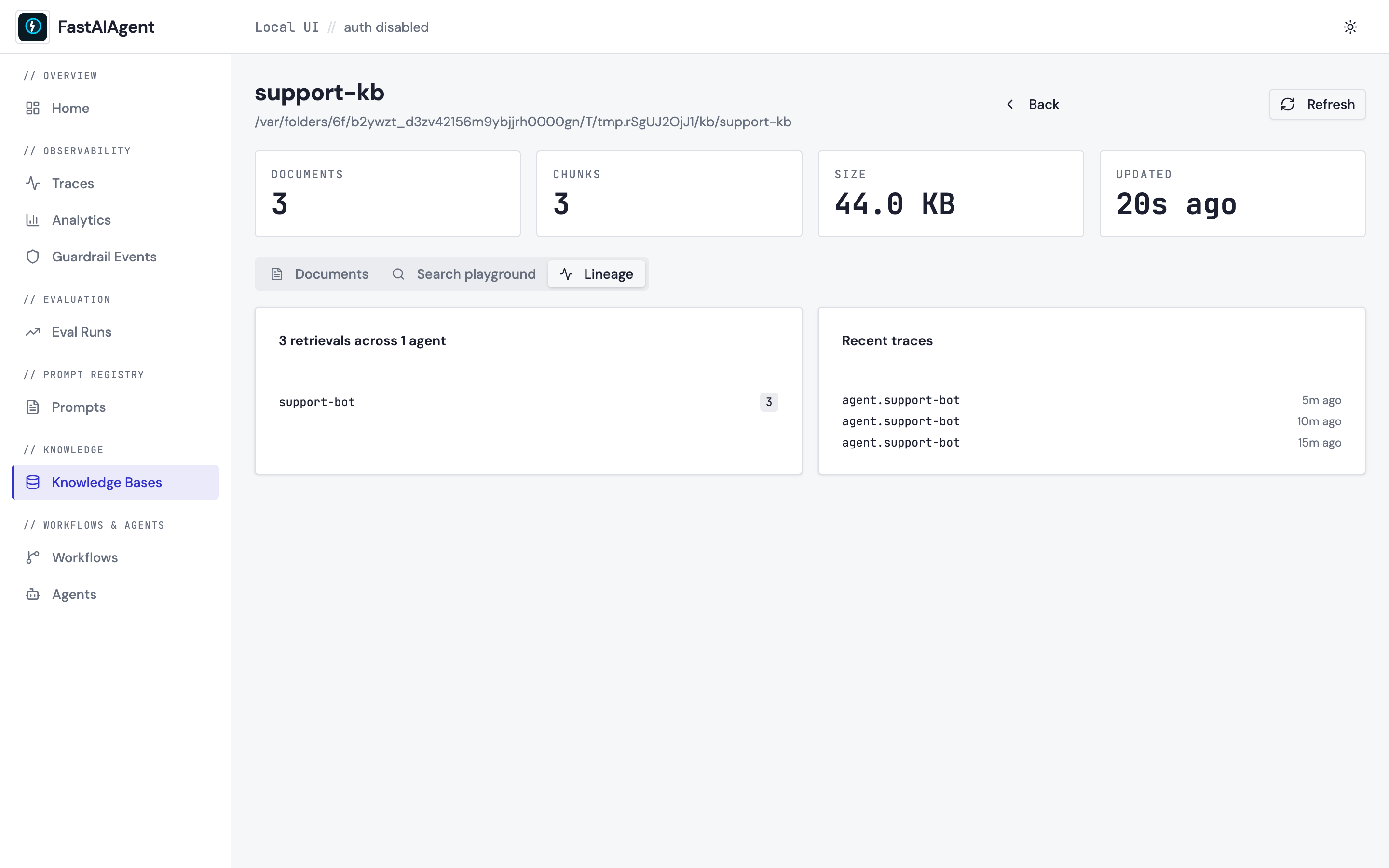 The Lineage tab of a KB in the Local UI: which agents searched it, how often, and the traces to open.
Code: as_tool in kb/local.py and kb/platform.py; the span is retrieval_span in kb/_tracing.py; the egress filter is apply_export_policy and SENSITIVE_ATTR_KEYS in trace/redaction.py; the lineage query is ui/routes/kb.py. The proof is proof_4_tool.py (needs OPENAI_API_KEY); the RAG scorers are in examples/24_rag_eval.py; tests/test_kb_tracing.py pins the span.
5 · Between one process and the next: the store is the source of truth
Processes restart. FAISS and BM25 live in memory and go with the process. The design rule behind this boundary: SQLite is the source of truth, and every index is rebuilt from it, never re-embedded.
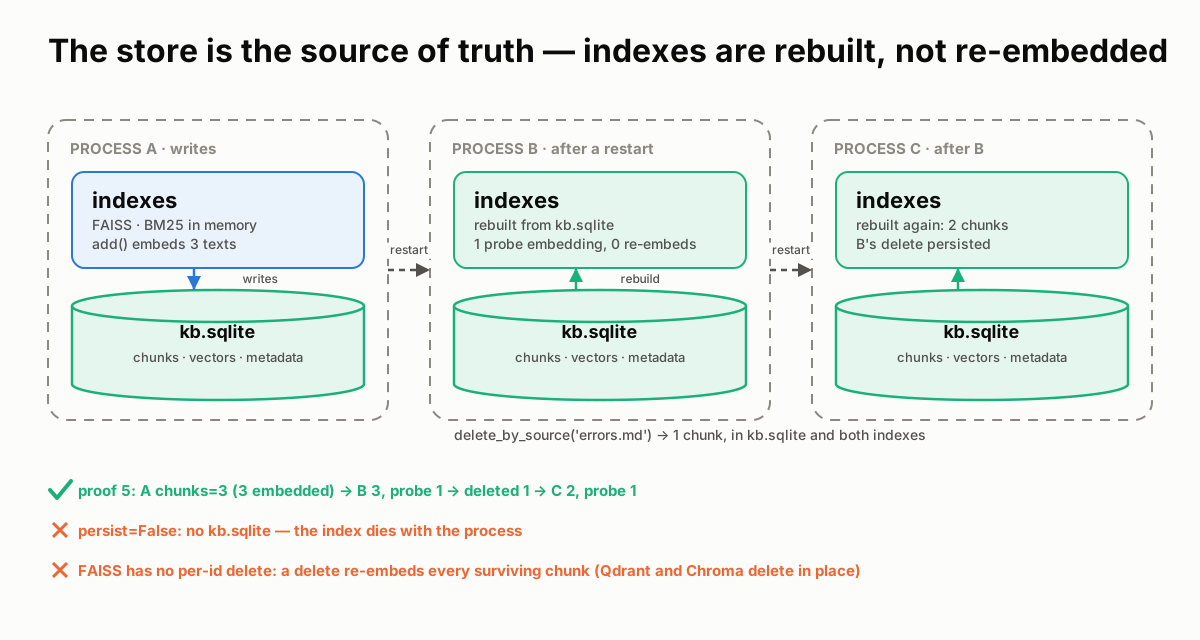 A writes; B rebuilds from the file with one probe embedding; B deletes; C sees it. The file is the only thing the three processes share.
The rules:
add()writes chunks and vectors tokb.sqliteand updates both in-memory indexes.- A new process rebuilds FAISS and BM25 from the file. It embeds one word to check the dimension, and then only queries.
- Deletes and updates persist and rebuild the indexes. On FAISS, which has no per-id delete, a delete re-embeds every surviving chunk; Qdrant and Chroma delete in place.
persist=Falsewrites nothing: no folder, no file, gone with the process.
Proof 5 writes in one process, reads and deletes in a second, and reads again in a third, counting every text the embedder was asked for:
── process A writes
chunks=3 embedded_texts=3 files=['kb.sqlite', 'kb.sqlite-shm', 'kb.sqlite-wal']

── process B reads, then deletes a source
chunks=3 embedded_on_open=1 (the probe) embedded_by_search=1 top=[0.700] Items can be sent back within 30 days …
deleted 1 chunk(s) from errors.md

── process C reads what B left
chunks=2 embedded_on_open=1 (the probe) embedded_by_search=1 top=[0.700] Items can be sent back within 30 days …

── persist=False
on disk: ['policies']
Three chunks cost three embeddings once. Every process after that paid one probe and one per query. The scratch KB left nothing on disk beside the persisted one.
Code: _load_from_metadata, delete_by_source and _rebuild_indexes_after_delete in kb/local.py; the file is kb/backends/sqlite.py. The proof is proof_5_restart.py; test_localkb_persists_across_reopen in tests/test_kb_backend_defaults.py pins the reopen.
6 · Between a laptop and a fleet: one contract, three backends, and the plane
The same LocalKB runs on FAISS, Chroma or Qdrant. Only vector_store= changes. All three implement one protocol with one promise about the score, and a sweep checks it against real instances of each.
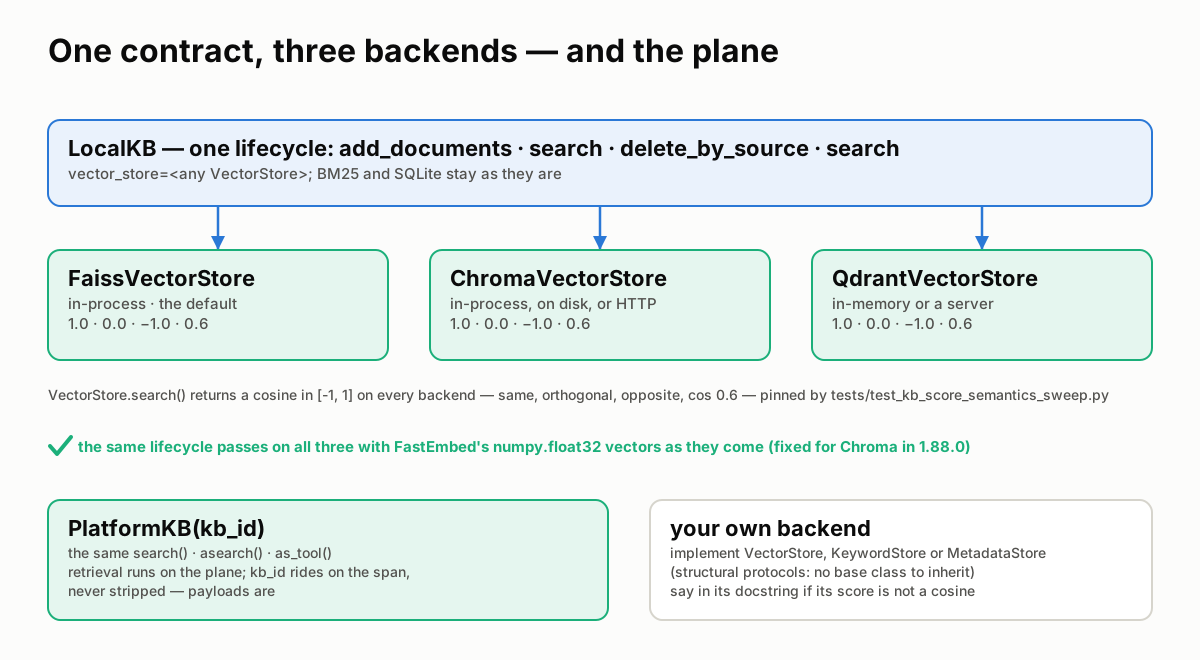 One lifecycle over three backends. The score contract holds on all three, and so does the lifecycle. The plane keeps the same interface.
The rules:
VectorStore.search()returns a cosine in[-1, 1]on every backend. The same pair scores the same whether the index is FAISS, Chroma or Qdrant. That contract was implied everywhere and written down nowhere until 1.67.0, when Chroma turned out to be returning2·cos − 1.- The protocols are structural. A backend implements the methods; there is no base class. A backend that cannot express a cosine should say so rather than return a different scale quietly.
PlatformKB(kb_id)has the samesearch(),asearch()andas_tool(). Retrieval, reranking and the stores run on the plane; the SDK is a thin client, andkb_idrides on the span.
Proof 6 runs the three-vector contract and then the same lifecycle on each backend, FAISS and Chroma in-process and Qdrant in-memory:
── the score contract: one stored vector, three queries
  faiss   {'same': 1.0, 'orthogonal': 0.0, 'opposite': -1.0, 'cos=0.6': 0.6}
  chroma  {'same': 1.0, 'orthogonal': 0.0, 'opposite': -1.0, 'cos=0.6': 0.6}
  qdrant  {'same': 1.0, 'orthogonal': 0.0, 'opposite': -1.0, 'cos=0.6': 0.6}

── the same LocalKB lifecycle over each backend, FastEmbed vectors as they come
  (FastEmbed returns numpy.float32 values inside Python lists)
  faiss   FaissVectorStore  top before delete: refunds.md · removed 1 · top after: errors.md
  chroma  ChromaVectorStore top before delete: refunds.md · removed 1 · top after: errors.md
  qdrant  QdrantVectorStore top before delete: refunds.md · removed 1 · top after: errors.md
The contract held on all three, and the same lifecycle code ran unchanged on each, with the vectors exactly as the local embedder returns them.
Changed in 1.88.0
Until 1.88.0 the Chroma line read ValueError: Chroma 1.x refuses a Python list of numpy.float32, which is what FastEmbed returns, while FAISS and Qdrant accept it. The Chroma backend now converts to plain floats on the way in. Its tests had used the fallback embedder, which returns plain floats, which is why they never saw it.
Code: kb/backends/faiss.py, kb/backends/chroma.py (the upsert in add) and kb/backends/qdrant.py; the plane client is kb/platform.py. The proof is proof_6_backends.py; the contract sweep is tests/test_kb_score_semantics_sweep.py; examples/28_kb_chroma.py, 29_kb_qdrant.py and 34_platform_kb.py wire each one up. See Backends, Custom Backend and Platform KB.
Where retrieval bugs hide
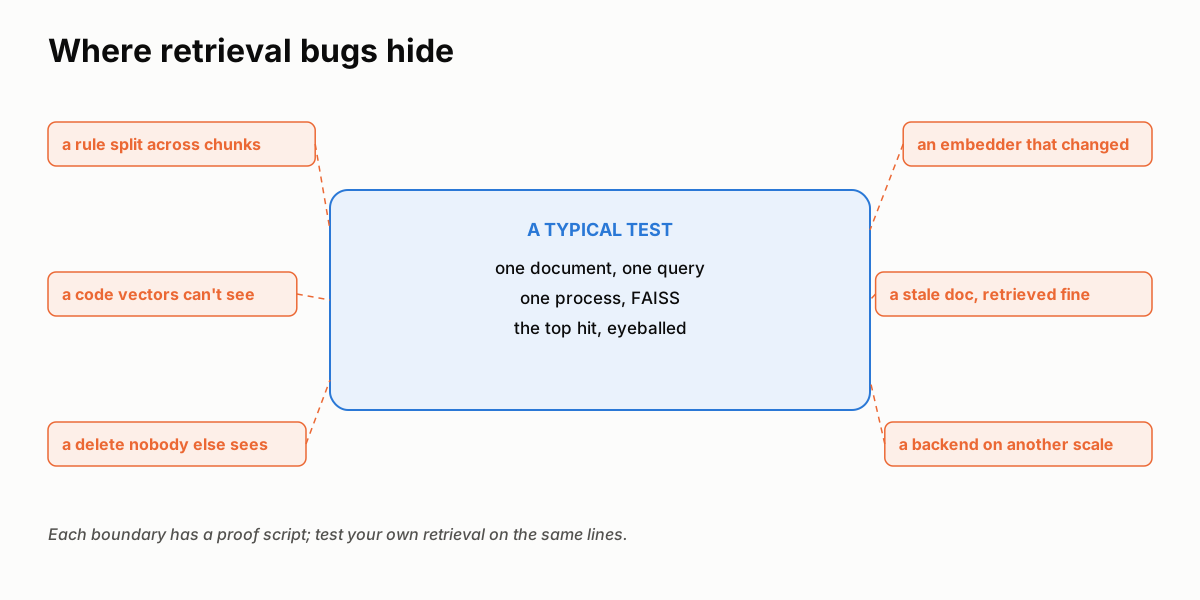 A typical test adds one document, runs one query in one process on FAISS, and reads the top hit. Retrieval breaks on the lines around that box.
If you build or buy retrieval, test the boundaries:
- Ask for a rule that spans a chunk boundary. Which half comes back?
- Ask the same question in other words, and with the exact code. Which matcher found it, and what did the fused number mean?
- Swap the embedder on an existing index. Was it refused, and would it be if only the model changed?
- Open the trace and read
doc_ids. Is the document that was retrieved the one that is current? - Cross a process. Write in one, delete in another, read in a third, and count the embeddings.
- Change the backend, and score the same three vectors. Do you get the same three numbers?
The proof scripts behind this page run each of those checks.
What the knowledge base still won't do for you
- An index keeps the chunks it was built with. A KB ingested before 1.88.0 has no overlap until you re-ingest it.
search()takes a query andtop_k, nothing else. There is no metadata filter; keep separate KBs for separate domains and give the agent one tool per KB.- A hybrid score is not a threshold. It is a rank position when both sides return, and a cosine when one doesn't.
- A reopen checks the dimension, not the model. Record which embedder built an index, and rebuild when you change it.
- A FAISS delete re-embeds the survivors. Fine for a small corpus; use Qdrant or Chroma when deletes are frequent.
- No reranker locally.
PlatformKBruns the plane's reranking;LocalKBreturns the fused order as is. LocalKBis synchronous. The store protocols are sync;PlatformKBhasasearch().- The KB does not know a document is stale. That is what
doc_idsin the trace and the RAG metrics are for.
The point of all of it
A knowledge base is the step between your documents and the model's answer, and the one where a wrong answer looks most like a right one: the reasoning is sound, the document was stale. That is why retrieval has to be both visible and trustworthy. The retrieval span makes it visible; this page walked the six boundaries where it has to hold.
The split between the SDK and the plane stays the same. The SDK retrieves in your process, on FAISS, BM25 and SQLite or on your own Qdrant or Chroma. The plane hosts knowledge bases centrally, with reranking, behind the same search() and as_tool(). Everything on this page, except the plane itself, is in the open-source SDK.
Test your own retrieval the same way. The bugs aren't in the ranking; they're on the boundaries.
See also
- Concepts & Mental Model: what a KB is, why, and how retrieval works, in prose.
- Knowledge Base: every keyword, mode and CLI command.
- Backends, Custom Backend and Platform KB.
- Knowledge Bases browser: documents, a search playground and lineage in the Local UI.
- RAG metrics: faithfulness, relevancy, context precision and recall.
- Agent Memory Breaks at the Boundaries: the same approach for memory.