Managed governance (approval policies)
A connected agent can honor governance the platform admin defines centrally — no policy code in the agent. When the agent is about to call a tool the admin has flagged, the SDK asks the platform whether it may proceed; a high-stakes call pauses and hands the decision to your application, which asks its own user and resumes the run with the answer.
Who approves: your application, not the console (since 1.74.0)
The plane never approves a runtime tool call. It distributes the policy, records every pause and every resolution, reports on them (pending count, age, outcome, who resolved it, time to resolve) and flags a pause that outlives its policy's timeout — it never expires or decides one. Your application is already talking to the person who started the run; the plane is not. The console's approvals pages are a read-only record of what your application decided.
This builds on guardrails (local, in-process checks) by adding the
managed policy + pause/resume over the wire. It needs fa.connect().
For connect-time enrollment and the opt-in fail-closed posture (refuse rather
than run ungoverned when the plane is unreachable), see
Connected governance.
How it works
connect() ──▶ GET /policy (cache)
   tool call ──▶ matches a cached approval policy?
        │ no  ─▶ run normally
        │ yes ─▶ POST /policy/decide
                    ├─ allow            ─▶ run
                    ├─ deny             ─▶ refuse (tell the model why)
                    └─ require_approval ─▶ POST /runs/{id}/pending + PAUSE (checkpoint)
                                              arun() returns status="paused"
                                              your app asks its user
                                              aresume(Resume(approved=…))
                                                 ├─ approved ─▶ run the tool
                                                 └─ rejected ─▶ refuse (tell the model)
connect()pulls and caches the policy (GET /policy). On a pull failure it keeps the last-known cache.- Before a tool call whose name matches a cached approval policy's
tool_pattern, the SDK callsPOST /policy/decide. deny→ the call is refused and the model is told why (the run continues).require_approval→ the SDK postsPOST /runs/{id}/pending(so the plane can record the pause against its approval request) and pauses the agent (a real checkpoint).arun()returns the paused result to your code.- Your application resumes with
aresume(...). An approval runs the tool; a rejection never runs it — the model receives the refusal as the tool's result, exactly as fordeny. The resolution is reported to the plane with the resolver you pass.
Only tools that match a configured policy incur a /policy/decide round-trip;
everything else runs untouched.
Plane-authored guardrails (enforced at the edge)
The same GET /policy pull also carries guardrails authored on the plane. A
connected agent turns each distributed rule into a runtime guardrail and enforces
it alongside its local guardrails=[...] — at all four positions. An agent with
no local guardrails still blocks on a centrally-authored rule:
import fastaiagent as fa
from fastaiagent import Agent, LLMClient

# An admin created a "block-ssn-output" regex guardrail in the console.
fa.connect(api_key="fa_k_...", target="https://app.fastaiagent.net")

agent = Agent(name="support", llm=LLMClient(provider="openai", model="gpt-4o"))
#                                    ^ no guardrails=[...] defined locally
agent.run("Confirm my record: name Dana, SSN 123-45-6789.")
# -> GuardrailBlockedError(guardrail_name="block-ssn-output")
- No new check engine. A rule is mapped onto the SDK's own
regex/schema/classifier/llm_judge/content_safety/groundedness/topic/pii/secretsrunners (fastaiagent.guardrail.from_policy), so plane rules enforce exactly like local ones — including theon_errorfail policy. Acoderule (a server-side callable the SDK doesn't have) is skipped rather than silently passing. - Positions are mapped, and a mismatch is logged. The plane models a single
toolphase; the SDK splits it intotool_callandtool_result, so a planetoolrule is enforced on the call. Aguardrail_typethe SDK does not recognise falls back tooutputand, since 1.64.0, emits aWARNINGnaming the rule and the unrecognised value. Watch for it: the rule still runs, but not where it was authored to run — a rule written to gate the user's prompt would be inspecting the model's reply instead, and the console would show a healthy control sitting over an ungated input. - The rule does what it says. Each rule also carries an
action—block,warn,mask,overrideorreask— so a "Mask PII in output" rule authored in the console redacts inside your process rather than blocking the run. It carriesseverityandfloortoo; neither changes enforcement. See Actions, severity & floor. - Scoping. A rule attached to specific agents applies only to them; an
unattached rule is domain-wide. Built guardrails are memoized by policy
version, so an edit on the plane is picked up on the next pull. - Refresh.
fa.refresh_policy()re-pulls the policy mid-session to pick up a guardrail authored afterconnect(). - Local-only is unchanged. With no connection there is no policy cache, so a
local run enforces exactly its own
guardrails=[...]and pays nothing. - Plane rules stay plane rules. A reconstructed guardrail is marked
origin="plane", which keeps it out of the agent definition sent byagent.push()and stops it being enforced twice if you also pass it inguardrails=[...]. Both matter: the plane upserts pushed guardrails by name and attaches them to the pushing agent, so echoing a domain-wide rule back would narrow it to just that agent — silently dropping it for every other agent in the domain. You never need to pass plane rules in explicitly; the runtime injects them.
A groundedness rule needs its context
It is the one rule that reads a pair: an answer and the context the answer
was supposed to use. An output guardrail only receives the answer, so supply
the context with fa.guardrail_context(context=docs) around the run. Without
it the rule fails closed — scoring an answer against nothing would block
everything, which is worse than reporting that the rule could not run.
You don't need to pull them yourself
plane_guardrails_for_agent(...) exists for runtimes that aren't fa.Agent
(see Guardrails & evals without the runtime).
A connected fa.Agent already enforces plane rules with no code at all.
Enforcement is always local — the runtime is the enforcement point (see Who actually blocks). The plane authors and distributes; it never reaches into a running agent.
Enrolling an agent
Two things make an agent governable:
import fastaiagent as fa
from fastaiagent import Agent, FunctionTool, LLMClient
from fastaiagent.checkpointers.sqlite import SQLiteCheckpointer

fa.connect(api_key="fa_k_...", target="https://app.fastaiagent.net")

agent = Agent(
    name="banker",
    agent_id="<platform agent uuid>",        # (1) enroll: the id /policy/decide matches on
    llm=LLMClient(provider="openai", model="gpt-4o-mini"),
    tools=[FunctionTool(name="transfer_funds", fn=transfer_funds)],
    checkpointer=SQLiteCheckpointer("agent.db"),  # (2) needed to pause/resume
)
agent_idis the agent's platform UUID — it's sent to/policy/decideso the plane can match approval policies (and it validates the id). Without it, the agent isn't enrolled and the gate is a no-op.agent.push()registers the agent and sets it for you. An enrolled agent stays governed inside aSwarmor aSupervisor(before 1.74.0 their internal copies dropped the id, so a worker's policy-gated tool ran with no approval at all).- A
checkpointeris required so a paused run can be resumed. Without one, the pause cannot be saved and surfaces as anInterruptSignalexception (unless the agent runs inside a checkpointedChain, which then owns the pause).
Approving from your application
arun() returns the pause. Read the tool and its arguments from the pause, ask
your user, and resume with their answer and their identity:
from fastaiagent import Resume

res = await agent.arun("Transfer $500 to Bob.", execution_id="run-42")
if res.status == "paused" and res.pending_interrupt["reason"] == "policy_approval_required":
    ctx = res.pending_interrupt["context"]
    tool, args = ctx["tool"], ctx["tool_input"]      # "transfer_funds", {"amount": 500, "to": "Bob"}

    approved = ask_my_user(f"Allow {tool} with {args}?")   # your UI, chat reply, ticket...

    res = await agent.aresume(
        res.execution_id,
        resume_value=Resume(approved=approved, metadata={"resolver": "alice@acme.com"}),
    )
- The pause (
res.pending_interrupt["context"]) carriestool,tool_input(the arguments the model chose),run_id, the plane'sapproval_request_idandpending_id.run_idis the run you resume: the agent's own, or the enclosingChain's when the agent has no checkpointer and the Chain holds the pause. - The resume can happen later and elsewhere. The run is checkpointed, so
aresumeworks from another request or process that can reach the same checkpointer (or, when connected, the plane's replica). Keep theexecution_id. approved=Falserefuses the call. The tool never runs; the model receivesRefused: governance approval denied for 'transfer_funds'as the tool's result and continues, exactly as for adenyverdict.- Pass the resolver.
Resume.metadata["resolver"]is recorded on the plane's human-in-the-loop ledger as who decided — the evidence for human oversight (EU AI Act Article 14). Pass the identity of the person who answered. It is the only place that identity comes from; without it the ledger records the decision with no one attached. - The plane closes exactly this pause. Since 1.76.0 the resolution names the
pending run it resolves (
context.pending_id), so the plane matches it by id rather than by its position in the run. Nothing to do on your side.
wait_for_approval=True was removed in 1.76.0
Before 1.74.0 arun() blocked by default, polling GET /runs/{id}/pending for a
console decision. The plane retired that console approve/deny, so there is nothing
left to wait for: arun(..., wait_for_approval=True) now raises ValueError before
anything runs. Resume the pause from your application as shown above.
wait_for_approval=False is still accepted and does nothing.
A runnable end-to-end example is in examples/84_governed_agent.py.
When something other than your application runs the agent
A pause needs someone to resume it. When the agent is driven by an SDK surface that cannot, the pause is reported as a run that did not finish, never as an empty answer (1.78.0). None of these approves or rejects on anyone's behalf:
| Surface | What a pause becomes |
|---|---|
| MCP server | an MCP error naming the pause and its execution_id; the pause stays open for the operator to resolve |
MCP inner tools (expose_tools=True) |
policy checked per call: allowed runs, denied or approval-required is refused (a direct call cannot pause) |
simulate() |
the scenario stops there, unjudged, with error set |
evaluate() / pytest eval |
an errored case: unscored, counted in error_rate |
| Replay | ReplayError; a rerun is not governed |
Verified end-to-end
Guardrail actions (SDK 1.57.0, wire v1.9) are exercised against a live local
plane by tests/e2e/test_connected_guardrail_actions_e2e.py: a console-authored
"Mask PII in output" rule arrives over /policy, redacts a real agent reply
in-process, and lands a filtered event with a before/after diff — plus a
content_safety block naming the category that tripped, a groundedness rule
passing with context and failing closed without it, and floor surviving the
wire. The judges themselves run against a real model in
tests/e2e/test_guardrail_actions_e2e.py.
Approvals are exercised against a live local plane by
tests/e2e/test_connected_approvals_e2e.py (real gpt-4o-mini): a console-authored
approval policy pauses the run, the application rejects it, the tool never runs,
and the plane's ledger records kind=approval, rejected and the resolver the
application passed. The same paths — approve, reject, the deprecated wait expiring,
and the pause inside a Chain, Swarm and Supervisor — are pinned without a
plane in tests/test_governance_approvals.py.
On the platform
The admin manages the rules on the Approval Policies page (the tool_pattern
set, and a timeout_minutes the plane uses to flag a pause as overdue — never to
expire or decide it). The approvals pages are a read-only record: every pause,
its outcome, who resolved it and how long it took, as reported by your
application through the SDK.
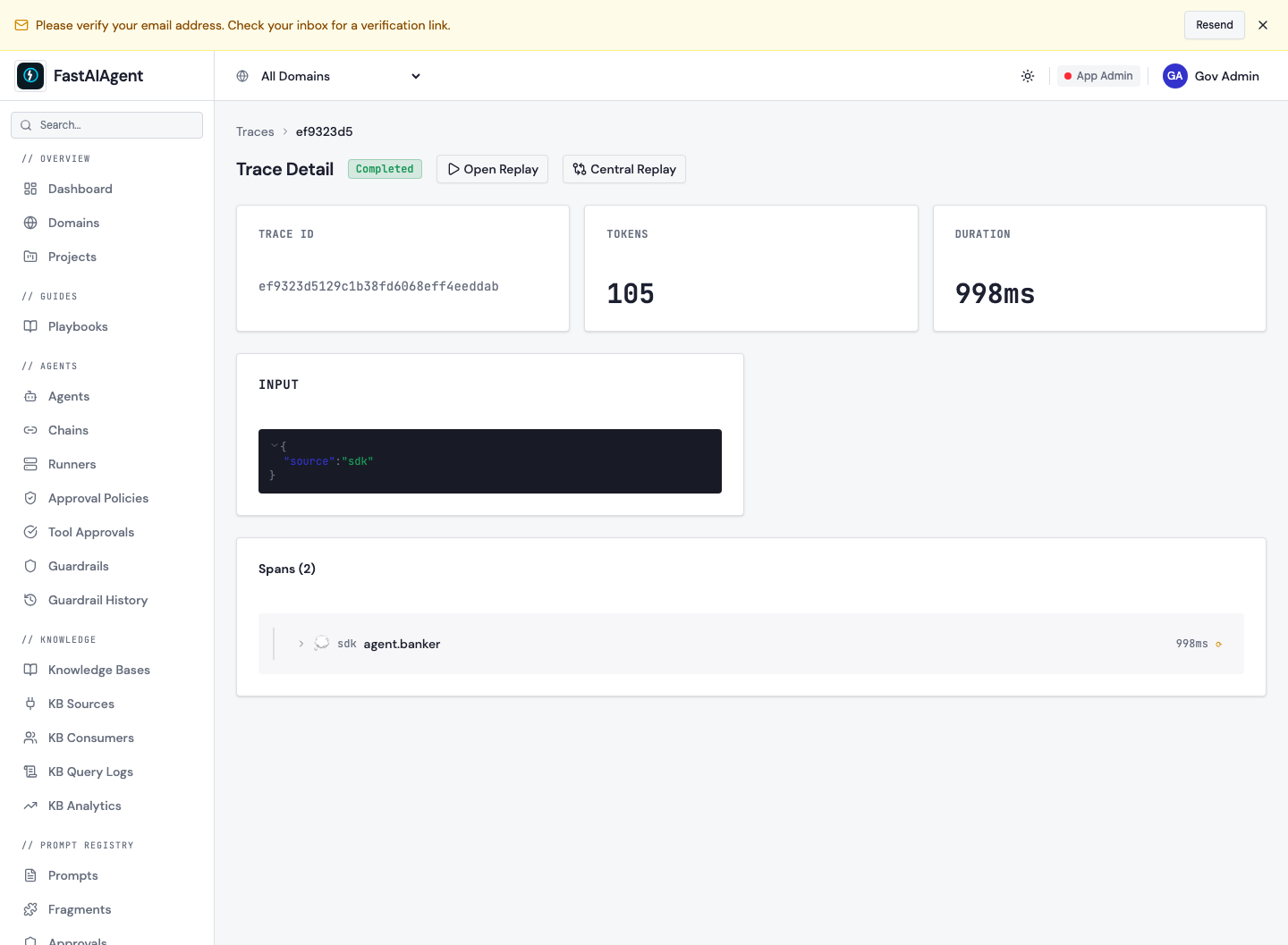
Each paused run is also a normal trace — the connected agent's run pushed to the
platform (here agent.banker):