Chains
A Chain is a directed graph workflow where nodes execute agents, tools, or logic, and edges define the flow between them. Chains support cycles (retry loops), typed state, checkpointing with resume, human-in-the-loop approval, parallel execution, and conditional branching.
Quick Start
from fastaiagent import Agent, Chain, LLMClient

summarizer = Agent(
    name="summarizer",
    system_prompt="Summarize the input in one sentence.",
    llm=LLMClient(provider="openai", model="gpt-4.1"),
)
translator = Agent(
    name="translator",
    system_prompt="Translate the input to French. Output only the French text.",
    llm=LLMClient(provider="anthropic", model="claude-sonnet-4-6"),
)

chain = Chain("summarize-and-translate")
chain.add_node("summarize", agent=summarizer)
chain.add_node("translate", agent=translator)
chain.connect("summarize", "translate")

result = chain.execute({"message": "Python is a popular programming language"})
print(result.output)
print(result.node_results)     # {"summarize": {...}, "translate": {...}}
print(result.execution_id)     # UUID for checkpointing/resume
Node Types
| Type | Purpose | Example |
|---|---|---|
agent |
Run an agent | chain.add_node("research", agent=my_agent) |
tool |
Execute a tool directly | chain.add_node("fetch", tool=my_tool) |
condition |
Branch based on state | See Conditional Branching |
transformer |
Render a template | chain.add_node("fmt", type=NodeType.transformer, template="Hello {{state.name}}") |
parallel |
Run multiple agents concurrently | See Parallel Execution |
hitl |
Pause for human approval | See Human-in-the-Loop |
start / end |
Explicit entry/exit points | chain.add_node("in", type=NodeType.start) |
The type is inferred from what you attach. agent= builds an agent node,
tool= builds a tool node, node= (a @node function) builds a tool node. Every other type needs type= because it has no
attachment to infer from. An explicit type= always wins, and agent= together
with tool= still means an agent node.
from fastaiagent.chain import NodeType

chain.add_node("classify", agent=classifier_agent)          # agent node
chain.add_node("fetch", tool=fetch_tool)                    # tool node
chain.add_node("transform", type=NodeType.transformer, template="Category: {{state.category}}")
chain.add_node("approve", type=NodeType.hitl)               # needs a hitl_handler at run time
A node with nothing to run now fails the run
Until 1.67.0, add_node("fetch", tool=my_tool) — the form this table used
to show — built an agent node with no agent, because only node=
inferred a type. The run then reported status="completed" with
{"error": "No agent attached to node 'fetch'"} as that node's output, and
chain.validate() returned [] because it only ever checked the graph.
A node that cannot run is now a failed run, not a completed one:
add_node refuses fn= / function= / func= / callable= and a tool=
that is not a Tool; the executor raises ChainError for an agent node with
no agent, a tool node with no tool, a transformer with no template, a
condition node with no conditions and a parallel node with no children; and
validate() reports all of those before the run starts. Because it is a
failed run rather than a completed one, it stays resumable once fixed.
Connecting Nodes
Simple Edges
Conditional Edges
Route flow based on chain state, the initial input, or the output of an earlier node:
chain.connect(
    "classify",
    "billing_agent",
    condition="{{node_results.classify.output}} == billing",
)
chain.connect(
    "classify",
    "tech_agent",
    condition="{{node_results.classify.output}} == technical",
)
chain.connect("classify", "general_agent")  # default fallback
Condition expressions support: ==, !=, >, <, >=, <=, contains, startswith. Values must be resolved via {{path.to.value}} templates against the chain context (input, state, node_results); bare identifiers like category are treated as literal text, not state lookups.
Routing semantics
Full contract
For the authoritative spec (including strict routing, parallel failure modes, validator rules, and the resume contract) see Execution Spec. The section below is a summary.
The executor walks edges in declaration order, applying these rules at each source node:
- All-unconditional fan-out — if every outgoing edge from a source has
condition=None, every target runs (the original chain behavior). - Mixed conditional + default — if any outgoing edge has
condition=set, the first matching condition in declaration order wins. A single unconditional sibling acts as the default fallback when no condition matches. NodeType.conditionnodes — the node returns{"matched": handle}; the outgoing edge whoselabelequals thathandlewins, with the unlabeled or"default"-labeled edge as fallback.- Dead branches — a node that no upstream branch routes to is silently skipped (it does not appear in
result.node_results).
chain.validate() enforces two structural rules at design time: a source mixing conditional and unconditional edges may have at most one default, and a condition node's outgoing edges must label every handle it can return (or provide a default). It also asks, per node, whether the node has anything to run at all — see Concepts.
Typed State
Validate the chain state at every step using JSON Schema:
chain = Chain(
    "typed-pipeline",
    state_schema={
        "type": "object",
        "properties": {
            "message": {"type": "string"},
            "category": {"type": "string"},
            "priority": {"type": "integer"},
        },
        "required": ["message"],
    },
)
chain.add_node("classify", agent=classifier)

# This works — message is present
result = chain.execute({"message": "My order is late", "priority": 1})

# This raises ChainStateValidationError — missing required field
result = chain.execute({"priority": 1})
State is validated: 1. Before execution starts (initial state) 2. After each node updates the state
Accessing State in Nodes
Each node receives the current state in its context. Agent nodes receive the input as their prompt. Transformer nodes can template against the full state:
chain.add_node(
    "format_output",
    type=NodeType.transformer,
    template="Customer {{state.name}} (priority: {{state.priority}}): {{node_results.classify.output}}",
)
Parallel Execution
Run multiple agents concurrently within a single node:
chain = Chain("parallel-pipeline")
chain.add_node("start", type=NodeType.start)
chain.add_node(
    "parallel_research",
    type=NodeType.parallel,
    agents=[researcher_1, researcher_2, researcher_3],  # Run all 3 in parallel
)
chain.add_node("merge", type=NodeType.transformer, template="Results: {{node_results.parallel_research.outputs}}")
chain.connect("start", "parallel_research")
chain.connect("parallel_research", "merge")
Parallel nodes use asyncio.gather() for concurrent execution.
Conditional Branching
Route execution based on state or previous node output:
chain = Chain("routing-pipeline")
chain.add_node("classify", agent=classifier_agent)
chain.add_node(
    "router",
    type=NodeType.condition,
    conditions=[
        {"expression": "category == billing", "handle": "billing"},
        {"expression": "category == technical", "handle": "technical"},
    ],
)
chain.add_node("billing_agent", agent=billing_agent)
chain.add_node("tech_agent", agent=tech_agent)

chain.connect("classify", "router")
chain.connect("router", "billing_agent", condition="category == billing")
chain.connect("router", "tech_agent", condition="category == technical")
Routing on meaning: decision nodes
New in 1.84.0. conditions= compares strings in state. decision= routes on
what the input means, with no classifier agent in front. The node asks
OpenAI's Decisions API a Choice about the rendered
input, and follows the edge labelled with the chosen value:
from fastaiagent.llm import Choice

chain.add_node(
    "triage",
    type=NodeType.condition,
    decision={
        "question": Choice(
            instructions="Which team should handle this support ticket?",
            options={"billing": "Payments and refunds", "technical": "Bugs and outages", "other": None},
        ),
        "input": "{{input.message}}",     # template over state; default "{{input}}"
        "llm": {"model": "gpt-6-luna"},   # LLMClient kwargs (this is the default model)
        "min_confidence": 0.6,            # below it, take the default edge
    },
)
chain.connect("triage", "billing_agent", label="billing")
chain.connect("triage", "tech_agent", label="technical")
chain.connect("triage", "human", label="other")
chain.connect("triage", "human")          # default: refusal or low confidence
- One edge label per option. The validator reports an option no edge labels,
just as it does for an unlabelled
conditionshandle. - A refusal, or a confidence under
min_confidence, takes the default edge. The chain never guesses a branch. - Boolean options route on
"True"/"False"labels. UseChoice(options=[True, False])for a yes/no gate. decision=Choice(...)is a shorthand for{"question": ...}.- The node's result is
{"matched": "<label>", "decision": {"choice",
  "confidence", "refused"}}
, available inChainResult.node_results. - It serialises. The question is stored in its wire form and
llmas kwargs, so the chain round-trips throughto_dict()/from_dict(). That's also whyllmtakes kwargs rather than a live client. - A failed call fails the node, like any other node error.
See 103_decision_routing.py
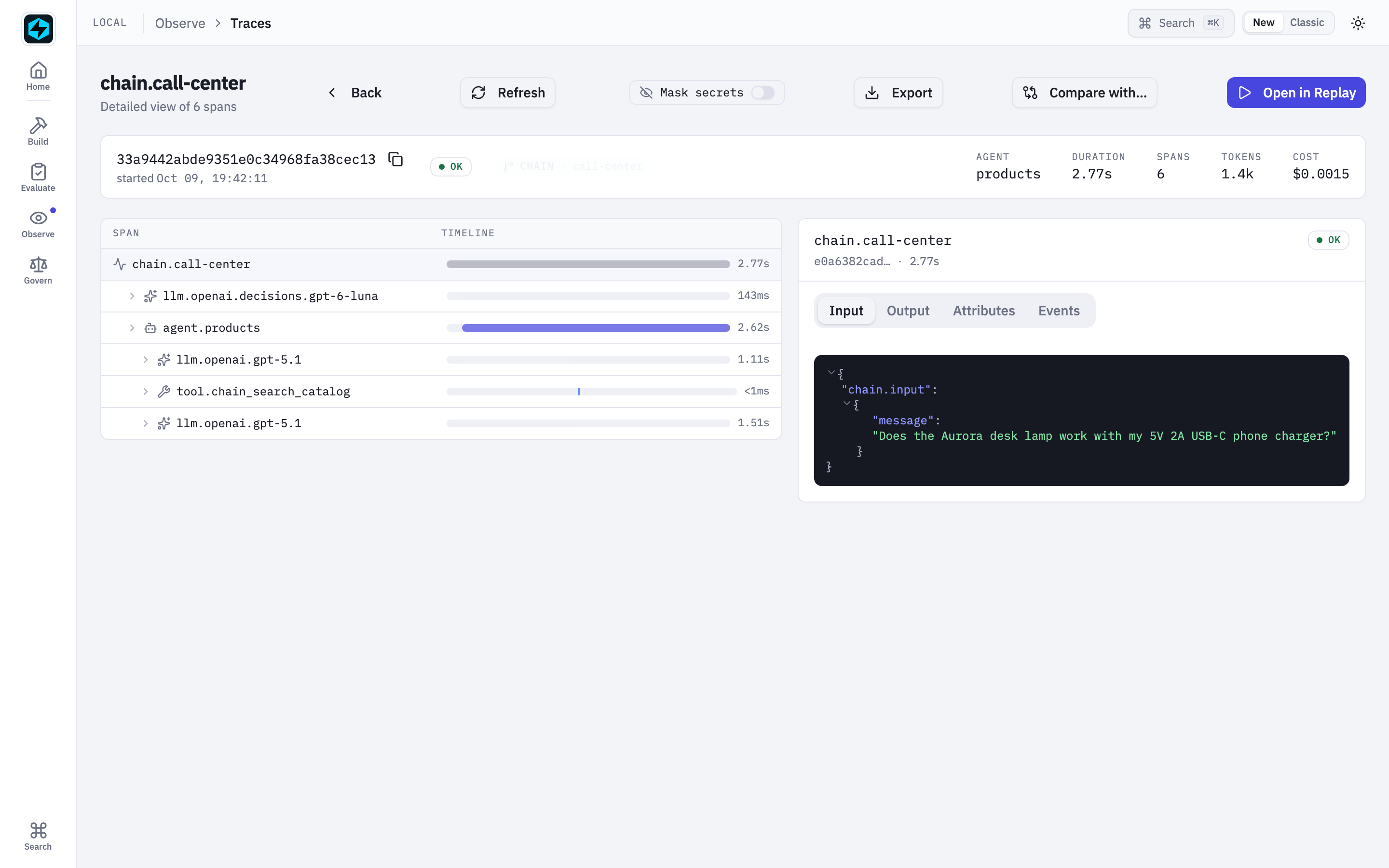
and the call-centre walkthrough in 107_call_center_chain.py.
In the trace, the triage decision comes first, then only the branch it chose:
Chain Validation
Validate chain structure before execution:
errors = chain.validate()
if errors:
    for e in errors:
        print(f"Error: {e}")
else:
    print("Chain is valid")
Checks for:
- Missing edge targets (referencing nonexistent nodes)
- Orphaned nodes (no incoming or outgoing edges)
- Cyclic edges without max_iterations
- Routing ambiguity (more than one default edge; an unlabeled condition handle)
- Nodes with nothing to run — an agent node with no agent, a tool node with
no tool, a transformer with no template, a parallel node with no children, a
condition node with no conditions
The last group is new in 1.67.0 and is the design-time half of a run-time
refusal: the executor now raises on each of them, and validate() is the same
finding reported before the run starts and before the model bill. An approval
gate is deliberately not in the list — its handler is an argument to
execute(), so at validate() time there is nothing yet to be missing.
Tool Node State Behavior
When a tool node executes, its return value is wrapped in {"output": <return_value>, "error": None} and merged into chain state. This means each successive tool node overwrites state.output with its own wrapped result.
A tool node whose tool could not run fails the run (1.78.0)
If the tool reports an error — its arguments fail validation, it has no
function, an MCP server answers isError — the executor raises
ChainError naming the node, the nodes after it do not run, and a
checkpointed run is marked failed (so it can be fixed and resumed). A tool
that raises already failed the run. Until 1.78.0 a returned error was
stored as {"output": None, "error": "..."}, downstream nodes ran on it,
and the run reported status="completed".
The common trigger is input_mapping: templates render state values as
strings, so {"amount": "{{state.amount}}"} with a missing or non-numeric
state.amount fails a tool declared amount: int.
The tool's own execution policy applies (1.78.0): a tool node runs its tool
the way the agent loop does, so the tool's timeout, max_retries /
retry_delay and output_type all take effect — a timeout or an output_type
mismatch fails the run, and a failing call is retried first. With output_type,
the value stored in state is the JSON form of the validated value (a Pydantic
model becomes a dict), because checkpoints are JSON. Before 1.78.0 a chain skipped
all three. See Tools → execution policy.
If you need to thread a value across multiple tool nodes (e.g., a seed_value that step A produces and step C reads), put it on the top-level state via initial_state to chain.execute() or modified_state to chain.resume() — not as a return value from a tool node. Top-level state keys persist because nothing overwrites them.
# This is fragile — step_c can't reliably read step_a's output
# because step_b's output overwrites state.output

# This is reliable — seed_value persists at the top level
result = chain.execute({"seed_value": "original", "message": "go"})
# In the tool node, read via input_mapping:
#   input_mapping={"seed": "{{state.seed_value}}"}
Agent nodes do not have this wrapping quirk — their output is stored under _{node_id}_output in state, preserving it across nodes.
ChainResult
Every chain execution returns a ChainResult:
| Field | Type | Description |
|---|---|---|
output |
Any |
Final node's output |
final_state |
dict |
Chain state after all nodes complete |
execution_id |
str |
UUID for checkpointing and resume |
node_results |
dict |
Map of node_id -> output for each executed node |
result = chain.execute({"message": "Hello"})

# Access individual node outputs
for node_id, output in result.node_results.items():
    print(f"{node_id}: {output}")
Serialization
Chains serialize to a ReactFlow-compatible JSON format (used by the platform visual editor):
# Serialize
data = chain.to_dict()
# {
#   "name": "my-pipeline",
#   "nodes": [{"id": "a", "type": "agent", "label": "A", "position": {"x": 0, "y": 0}, ...}],
#   "edges": [{"source": "a", "target": "b", "is_cyclic": false, ...}],
#   "state_schema": {...}
# }

# Restore
chain = Chain.from_dict(data)
This canonical format can be used to serialize/deserialize chains for storage or transfer.
Sync vs Async
# Sync
result = chain.execute({"input": "data"})

# Async
result = await chain.aexecute({"input": "data"})

# Async resume
result = await chain.resume(execution_id="<id>")
Error Handling
from fastaiagent._internal.errors import (
    ChainError,                   # Base chain error
    ChainCycleError,              # Cycle exceeded max_iterations
    ChainCheckpointError,         # Checkpoint save/load failed
    ChainStateValidationError,    # State failed schema validation
)

try:
    result = chain.execute({"input": "data"})
except ChainCycleError as e:
    print(f"Cycle limit hit: {e}")
except ChainStateValidationError as e:
    print(f"Invalid state: {e}")
except ChainCheckpointError as e:
    print(f"Checkpoint error: {e}")
Complete Example
A support pipeline with classification, conditional routing, retry loop, and approval:
from fastaiagent import Agent, Chain, LLMClient
from fastaiagent.chain import NodeType

llm = LLMClient(provider="openai", model="gpt-4.1")

chain = Chain(
    "support-pipeline",
    state_schema={
        "type": "object",
        "properties": {
            "message": {"type": "string"},
            "category": {"type": "string"},
        },
        "required": ["message"],
    },
)

# Nodes
chain.add_node("classify", agent=Agent(name="classifier",
    system_prompt="Classify the support request. Set category.", llm=llm))
chain.add_node("research", agent=Agent(name="researcher",
    system_prompt="Research the issue thoroughly.", llm=llm))
chain.add_node("draft", agent=Agent(name="drafter",
    system_prompt="Draft a helpful response.", llm=llm))
chain.add_node("review", type=NodeType.hitl)
chain.add_node("send", agent=Agent(name="sender",
    system_prompt="Finalize and send the response.", llm=llm))

# Flow
chain.connect("classify", "research")
chain.connect("research", "draft")
chain.connect("draft", "review")
chain.connect("review", "send")

result = chain.execute(
    {"message": "My order hasn't arrived"},
    hitl_handler=lambda n, c, s: True,  # Auto-approve for demo
)
print(result.output)
Dependency injection — RunContext
Pass a RunContext to chain.execute(...) / chain.aexecute(...) to make
shared dependencies available to every tool and agent node, identical to the
contract you'd use on a plain Agent:
from dataclasses import dataclass
import fastaiagent as fa
from fastaiagent.chain import Chain, NodeType

@dataclass
class Deps:
    db: ...           # connection pool, API clients, tenant id, etc.

@fa.tool()
def write_record(payload: dict, ctx: fa.RunContext[Deps]) -> dict:
    return ctx.state.db.insert(payload)

chain = Chain("ingest", checkpoint_enabled=True)
chain.add_node("persist", tool=write_record,       # type inferred from tool=
               input_mapping={"payload": "{{state.input}}"})

ctx = fa.RunContext(state=Deps(db=my_pool))
result = await chain.aexecute({"input": {...}}, context=ctx)
Context flows through:
- every tool node —
tool.aexecute(args, context=ctx) - every agent node —
agent.arun(input, context=ctx) - every parallel child agent
- recursive cycle re-entries via cyclic edges
- resume runs — pass the same context to
chain.aresume(execution_id, ..., context=ctx)so a tool re-firing afterinterrupt()still seesctx.state
Context-propagation is opt-in: tools whose ctx parameter has a default of None continue to run unchanged when no context is supplied.
Next Steps
- Cyclic Workflows — Retry loops, max iterations, and exit conditions
- Checkpointing — Save and resume chain execution
- Human-in-the-Loop — Pause chains for human approval
- Agents — Core agent documentation
- Platform Sync — Push chains to the platform visual editor