OpenAI Decisions API
New in 1.84.0.
OpenAI's Decisions API (POST /v1/decisions, public beta) is not a chat endpoint.
You hand it evidence (text and/or images) and questions whose answers you
fixed in advance, and it returns a probability distribution for each question
instead of generated text. There's no prompt to engineer and no JSON to parse.
OpenAI's guide says it answers about 10× faster than asking the same model through
the Responses API. It bills input tokens only. The endpoint serves one
model today, gpt-6-luna.
from fastaiagent.llm import Choice, LLMClient, Predicate, Score

llm = LLMClient(model="gpt-6-luna")
r = llm.decide(
    "I was charged twice for the same subscription renewal.",
    {
        "department": Choice(
            instructions="Which department should handle this?",
            options={"billing": "Payments and refunds", "technical": "Product bugs", "other": None},
        ),
        "duplicate": Predicate(instructions="The customer reports a duplicate charge."),
        "severity": Score(instructions="How severe is this?", levels=["Cosmetic", "Inconvenient", "Blocking"]),
    },
)
r.choices["department"].choice        # "billing"
r.predicates["duplicate"].probability  # 1.0
r.scores["severity"].level             # "Inconvenient"
r.cost_usd                             # 5e-05
Runnable versions: 102_decisions_basics.py
through 105_decision_replay.py.
When to use it
| You need | Use |
|---|---|
| A yes/no probability, one label from a fixed set, or a rating on a fixed scale | decide() |
| Extracted fields, or an object matching your own schema | Structured output (acomplete(output_type=...)) |
| The model to call tools with arguments | An Agent with tools |
| Generated text | acomplete() / Agent.run() |
Classification, routing, triage, moderation, relevance and "did this answer meet
the bar?" checks all fit decide(). Anything that has to write something doesn't.
Questions
| Question | You supply | Main result |
|---|---|---|
Predicate(instructions) |
a condition about the input | probability (0..1) that it holds |
Choice(instructions, options) |
2+ unordered options | choice, every option's probabilities, confidence |
Score(instructions, levels) |
2+ ordered levels, lowest first | score, per-level probabilities, confidence |
- Phrase a predicate as a statement, not a question to answer in prose:
"The customer reports a duplicate charge." optionsaccepts a list (["billing", "other"]), a mapping of value to description ({"billing": "Payments and refunds", ...}), orOption(value, description)objects. Include a catch-all such as"other"when the options may not cover every input.- Choice values are typed.
options=[True, False]returns the booleanTrue, and the string"true"would be a different option. levelsaccepts labels orLevel(label, description).- Pass one question, a list, or a
{name: question}mapping. The key becomes the question's name.
A question that can't decide anything raises ValueError when you build it,
before any call is made. That covers empty instructions, fewer than two
options or levels, a repeated option, and two questions with the same name.
Answers
decide() returns a DecisionResult. Answers come back in question order.
r[0]                        # by position
r["department"]             # by name
r.predicates / r.choices / r.scores   # {name: answer}, filtered by type
r.refusals, r.refused       # see below
r.usage, r.cost_usd, r.latency_ms, r.request_id, r.model
score is not 0..1. It's the probability-weighted level index, so with
three levels it runs from 0 to 2 and can fall between levels: probabilities
0.1 / 0.7 / 0.2 give 1.1. Use ScoreAnswer.normalized for a 0..1 value, and
ScoreAnswer.level for the single most likely label.
OpenAI doesn't publish how confidence is computed. Pick thresholds from labelled
examples of your own traffic, weighing what a false positive and a false negative
each cost you.
Refusals
Any single answer can come back as Refusal(name), and the other questions in
the same request are still answered. The SDK never turns a refusal into a score.
Every integration below treats one as "could not decide":
| Where | A refusal means |
|---|---|
decide() |
a Refusal in r.answers; r.refused is True |
Guardrails (backend="decisions") |
the rule could not run: errored=True, and on_error decides |
DecisionJudge |
score 0.0, not passed, with a reason saying so |
| Chain decision node | the default edge |
Supervisor routing="decisions" |
the fallback_worker |
decision_tool |
{"refused": true} for that question |
| Supervisor validation | fail-open (approved, with a warning), the same as a failed call |
An answer the SDK can't read raises LLMError naming what arrived. That covers a
count that doesn't match the questions, or an answer type it doesn't know (the API
is in beta). The SDK never guesses, and never silently drops an answer.
Input
- A
str. - An
Image, or a list mixingstrandImage(sent as one user message). - A list of
UserMessageobjects.
from fastaiagent.multimodal.image import Image

llm.decide(
    ["What colour fills this image?", Image.from_file("photo.png")],
    Choice(name="colour", instructions="Dominant colour", options=["red", "green", "blue"]),
)
Images are always sent inline as base64 data URLs, because OpenAI's types reject
external URLs and file ids. An Image.from_url(...) is therefore sent as its bytes.
detail passes through. PDFs, files, audio, and system/assistant/tool messages
aren't accepted by the endpoint, so they raise LLMError rather than being
silently converted.
Client, providers, errors
decide() lives on LLMClient, so it reuses that client's API key
(OPENAI_API_KEY), base_url, TLS verify, max_retries (429 and 5xx are
retried, 4xx are not) and the image size cap.
| Client | Works? |
|---|---|
LLMClient(provider="openai", model="gpt-6-luna") |
yes, the default |
LLMClient(provider="custom", base_url=...) |
yes, for a gateway or proxy that serves /decisions |
LLMClient(openai_client=OpenAI(...)) / AsyncOpenAI / AzureOpenAI |
yes, see below |
anthropic, ollama, bedrock, any preset |
no: LLMError says the endpoint is OpenAI-only |
No openai upgrade needed. The SDK calls the endpoint itself over httpx.
With an injected openai_client, it uses client.decisions.create on openai
≥ 3.26. On the 1.x/2.x most installs pin, it falls back to the client's generic
client.post("/decisions"), which still uses the client's own base URL, auth
(including Azure AD token refresh) and http_client.
A non-200 raises LLMProviderError with OpenAI's message and .status_code.
For example, a model your key can't use comes back as a 404 model_not_found.
Cost
Priced at the decisions rate: gpt-6-luna is $0.10 per 1M input tokens, with
no output charge. That's separate from the chat price table, because the same
model id is billed differently there. Each call:
- sets
DecisionResult.cost_usd; - adds to the run's accumulated cost, so
AgentResult.costandcost_limitguardrails include decisions; - stamps
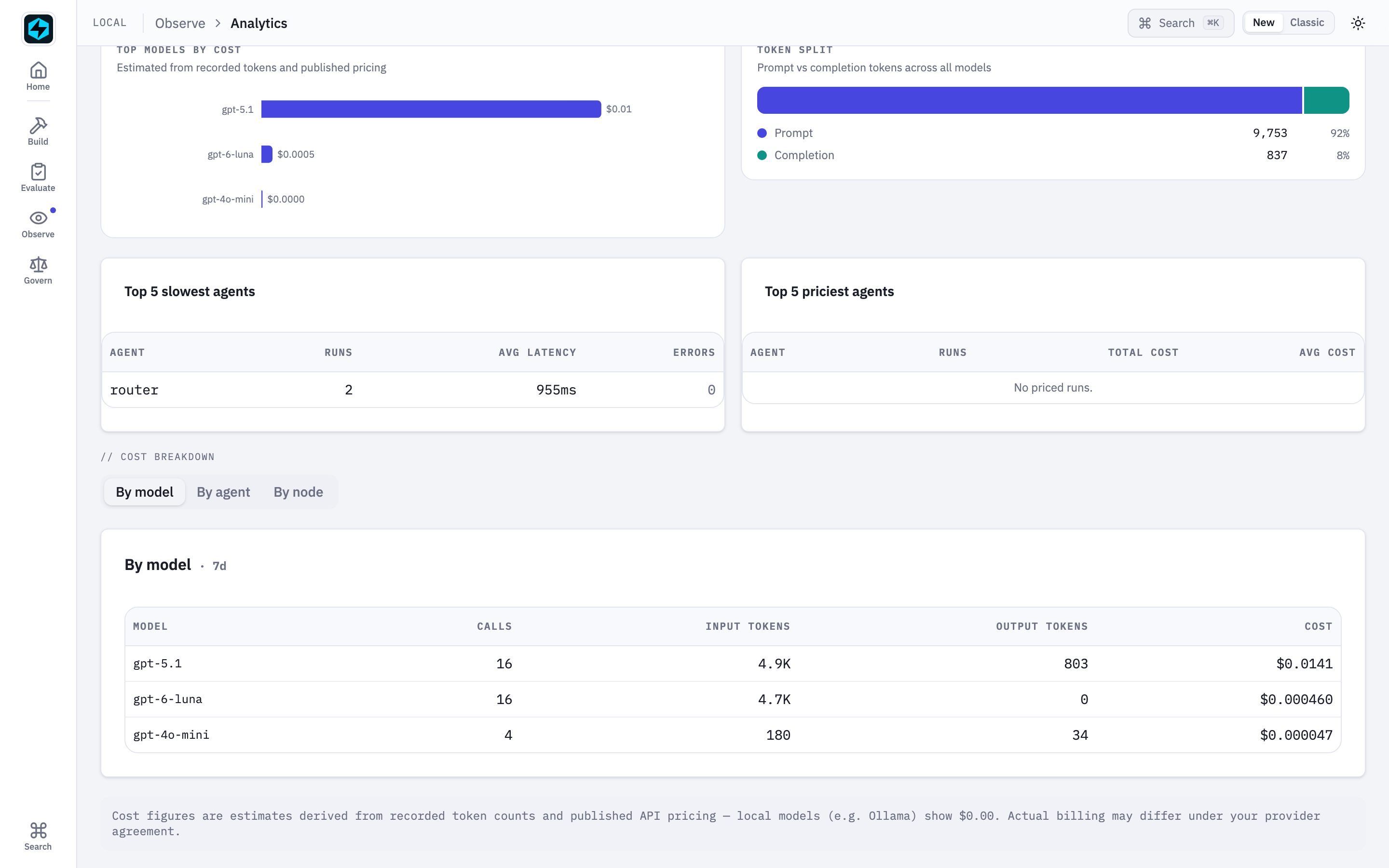
fastaiagent.cost.total_usdon its span, so the Local UI's per-model cost shows it.
A model with no known decision rate leaves cost_usd=None, and the run's cost is
reported as unknown rather than $0.00.
Tracing and egress
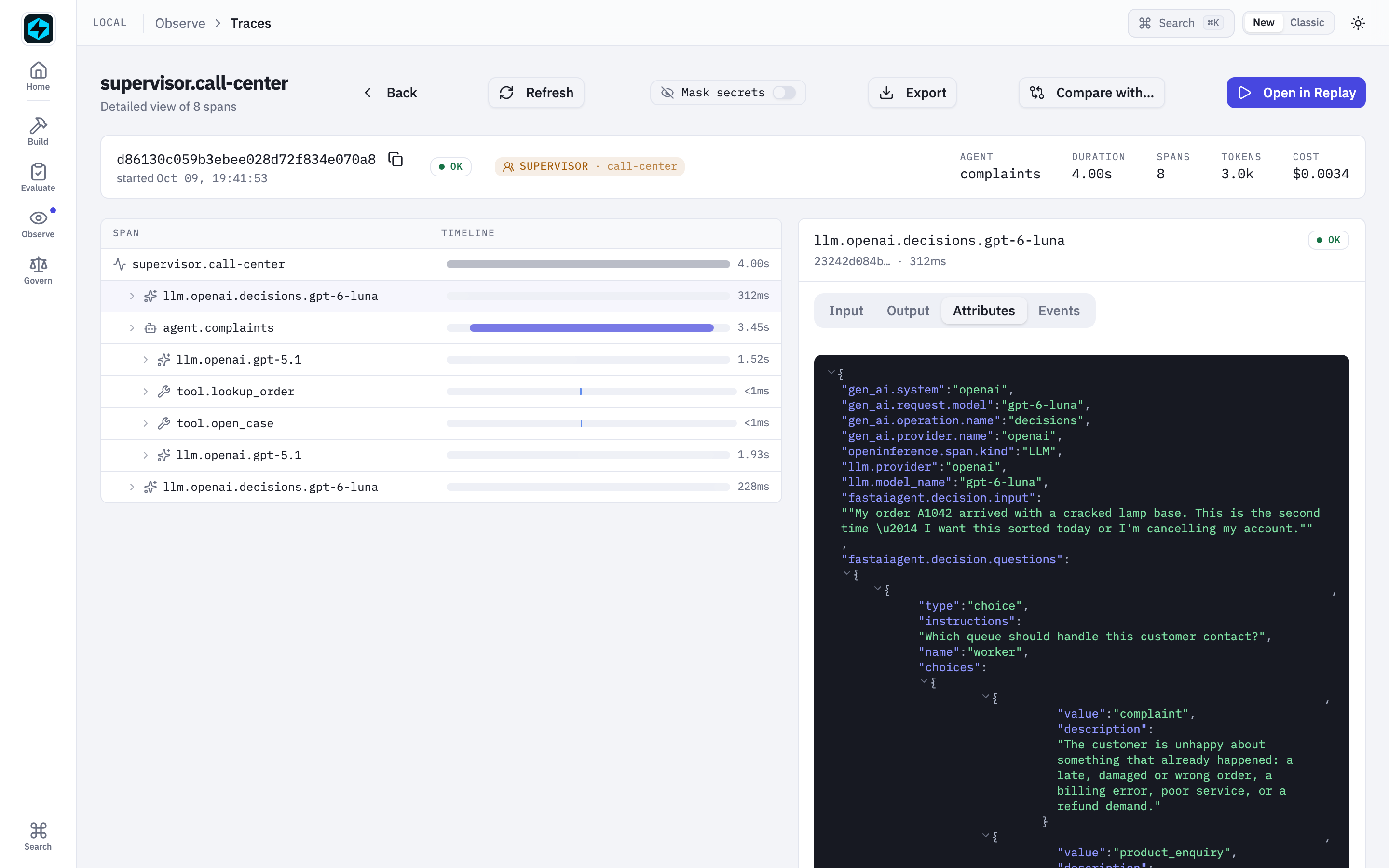
Each call emits one span named llm.<provider>.decisions.<model>: provider,
then the API, then the model. In a trace it sits next to chat spans such as
llm.openai.gpt-5.1:
supervisor.call-center
├── llm.openai.decisions.gpt-6-luna    ← a Decisions API call, made with gpt-6-luna
├── agent.complaints
│   ├── llm.openai.gpt-5.1             ← a chat completion
│   ├── tool.lookup_order
│   └── llm.openai.gpt-5.1
└── llm.openai.decisions.gpt-6-luna    ← the review
gpt-6-luna is the model. The Decisions API is how it's called: the same
model also answers through the Responses API, and OpenAI's guide compares the two
paths. Through a gateway (provider="custom") the span reads
llm.custom.decisions.<model>.
The span carries the SDK's own keys:
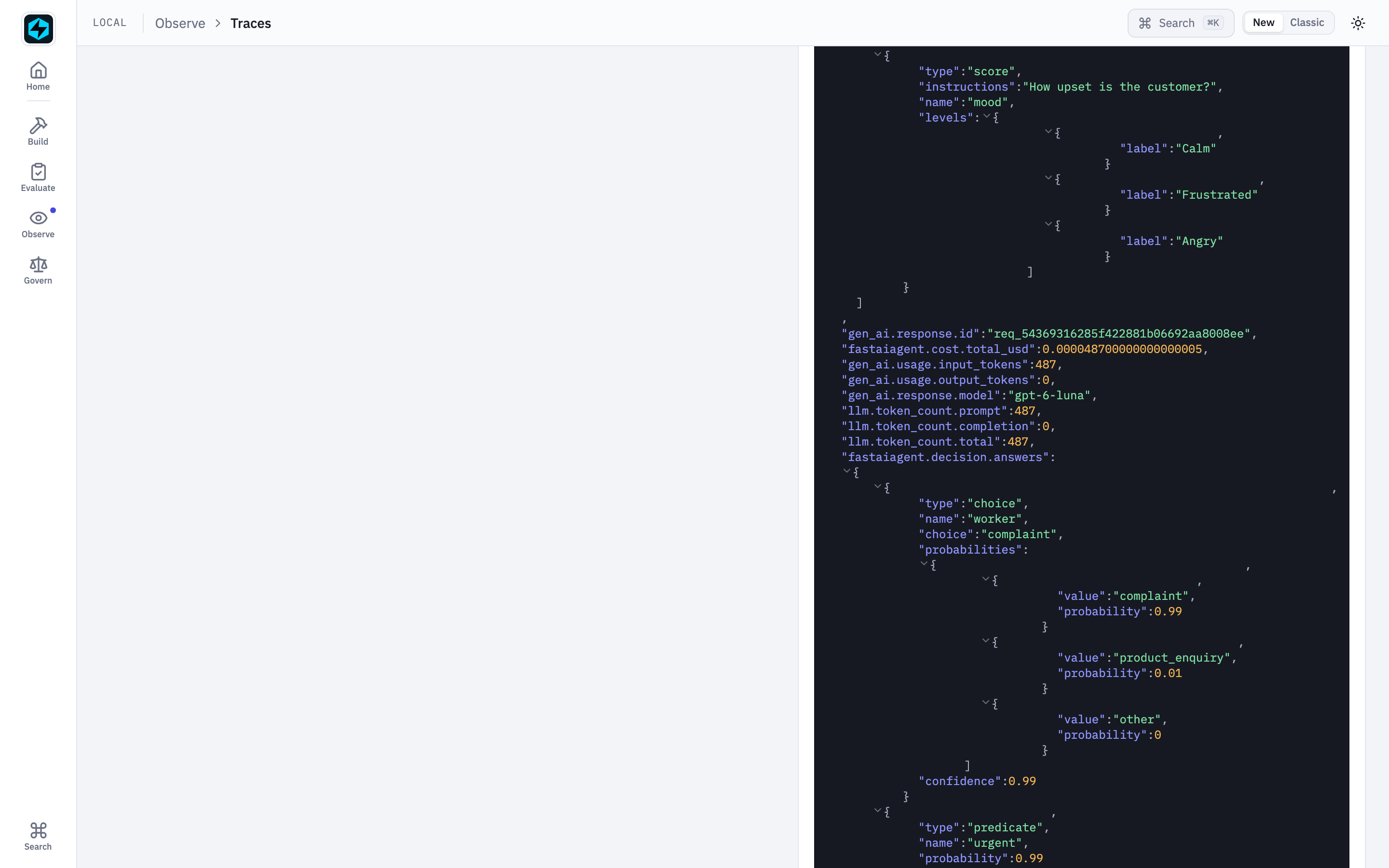
fastaiagent.decision.questions,fastaiagent.decision.answersandfastaiagent.decision.refusals;fastaiagent.cost.total_usd;fastaiagent.decision.input, a summary of the evidence. Images appear by type and size, never their bytes.
The evidence is user content, so fastaiagent.decision.input is stripped on export
when FASTAIAGENT_TRACE_PAYLOADS=0. It still stays in your local trace store for
the UI and Replay. The questions and answers are your own structure plus
probabilities, so they're exported the same way guardrail scores are.
In the Local UI, a Decisions span sits in the trace tree like any LLM call. Its Attributes tab shows the standard keys, the questions, and the answers with their probabilities:
OpenTelemetry and OpenInference
A Decisions call is a standard CLIENT-kind GenAI span, so any OTel backend
you register with fastaiagent.trace.otel.add_exporter(...) (Datadog, Jaeger,
Grafana, Langfuse, Phoenix and others) reads it as an LLM call with no
SDK-specific mapping:
| Convention | Attributes |
|---|---|
| OTel GenAI semantic conventions | gen_ai.operation.name="decisions" (named after the API, as chat is for /chat/completions), gen_ai.provider.name="openai", gen_ai.request.model, gen_ai.response.model, gen_ai.response.id, gen_ai.usage.input_tokens / output_tokens, plus gen_ai.system as on chat spans |
| OpenInference (Phoenix / Arize) | openinference.span.kind="LLM", llm.provider, llm.model_name, llm.token_count.prompt / completion / total |
The exporter goes through the same egress filter as the plane, so with
FASTAIAGENT_TRACE_PAYLOADS=0 the user's text never reaches it.
Replay
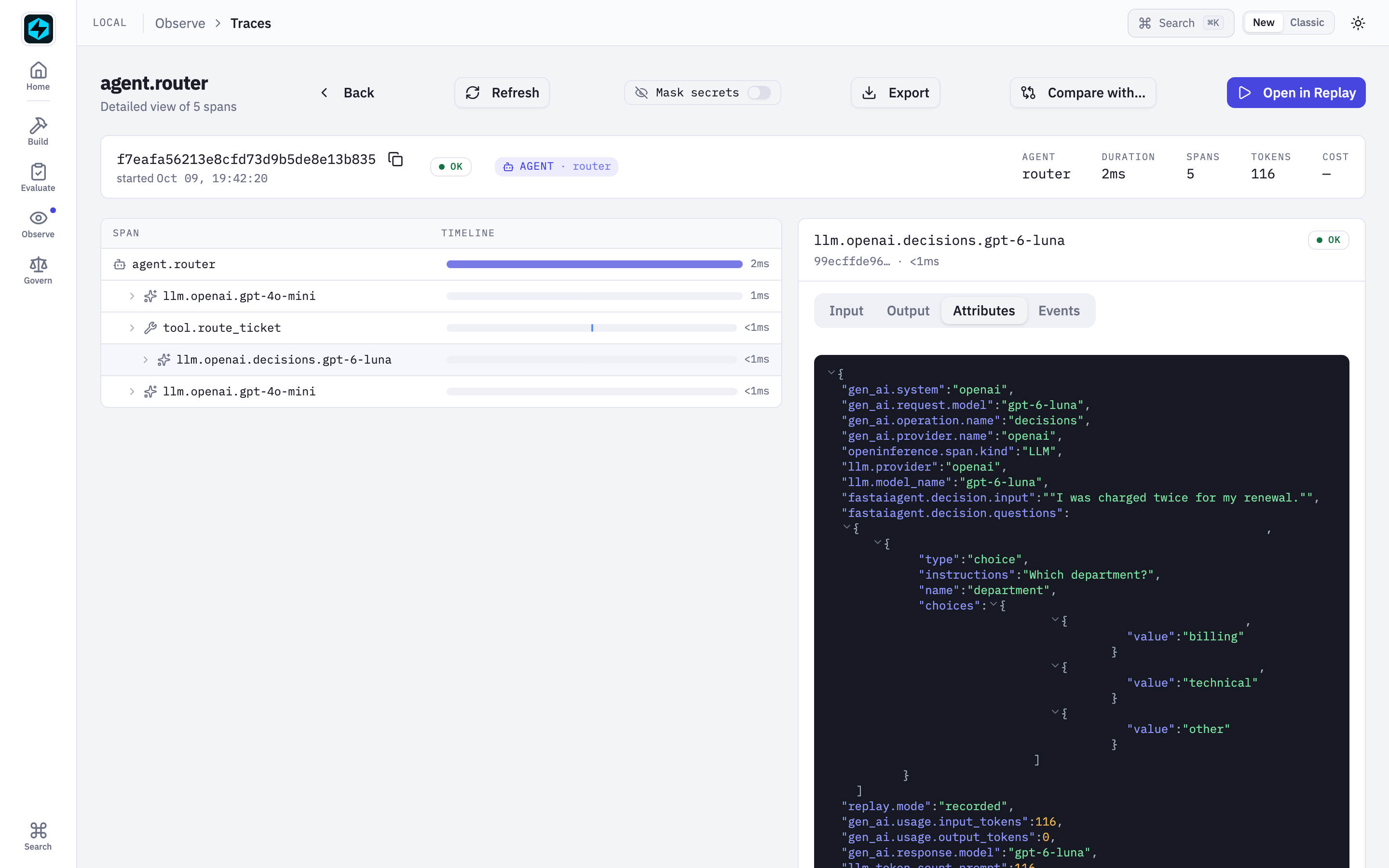
A recorded rerun (with_determinism("recorded")) serves each captured decision
back from the trace, in order, exactly as it serves captured chat turns. A
decision-driven agent therefore replays with no model calls at all:
from fastaiagent.trace.replay import Replay

rerun = await (
    Replay.load(trace_id)
    .fork_at(step=0)
    .with_determinism("recorded", on_miss="error")
    .arerun()
)
A rerun that asks a decision the original didn't is a miss, governed by
on_miss: "error" raises ReplayError, and "live" warns and calls. A miss
covers more decisions than were captured, or a captured decision that answered
different questions. See 105_decision_replay.py.
Testing without the network
from fastaiagent.testing import FunctionModel, TestModel

# Canned answers, served in order (the last repeats).
llm = TestModel(decisions={"answers": [{"type": "predicate", "name": "spam", "probability": 0.97}]})

# Or compute them.
def decide_fn(input, questions):
    p = 0.95 if "WIN $$$" in input else 0.05
    return {"answers": [{"type": "predicate", "name": questions[0].name, "probability": p}]}

llm = FunctionModel(lambda messages: "ok", decide_fn=decide_fn)
Both emit the same Decisions span a live call does (llm.test.decisions.<model>). A TestModel with no
canned decision raises rather than inventing one.
Built on decide()
| Feature | Page |
|---|---|
Guardrails with backend="decisions" (topic, content_safety, llm_judge) and mode="decisions" builtins |
Guardrails |
DecisionJudge, an eval judge that returns a probability |
LLM judge |
Chain condition nodes that route on a Choice |
Chains |
decision_tool, classification as an agent tool |
Function tools |
Supervisor routing="decisions": the Decisions API routes each request to one worker |
Teams |
Supervisor validation_mode="decisions" |
Teams |
Status
The Decisions API is in public beta (OpenAI expects GA "in the coming weeks").
The SDK follows OpenAI's published types (openai 3.26.0) and was checked against
the live endpoint. If the response shape changes, parsing fails loudly with
LLMError rather than misreading it.