Connected checkpoints (platform)
Checkpointing in the SDK is local-first: SQLiteCheckpointer (default) or
PostgresCheckpointer persists each step so a crashed or paused run can resume.
See Checkpointers and Durability — that works
fully standalone, with no platform dependency.
When you fa.connect() to an Enterprise control plane, the SDK additionally
replicates those checkpoints to the plane as a managed durable copy, and
can restore a run from the plane if the local store is lost. The local
checkpointer stays the hot-path source of truth; the plane is a passive replica
and system-of-record.
Serve, don't execute
The plane serves a checkpoint back; the SDK resumes locally. The plane
never runs agent or chain code — restoring fetches the checkpoint and a normal
local resume() continues from it. This keeps the open/closed boundary intact.
Local-first, non-blocking, one deliberate loss
Replication reuses the same durable outbox as trace export, but it is write-driven (checkpoints aren't tied to spans):
- The checkpointer writes locally first (
synced=0) — the durable source of truth. - On each write, when connected, it kicks a background drain that POSTs
un-acked checkpoints to
/public/v1/checkpoints/ingest(idempotent bycheckpoint_id) and marks themsynced=1only after a 2xx. - The agent hot path never blocks — the POST + retry run on a daemon thread.
Unlike traces (which abandon an old or oversized backlog), the checkpoint outbox
has no age or count bound: an un-acked checkpoint for an active or paused run
is never dropped just because it is old or the queue is deep. A transient
failure, a 5xx, a lapsed entitlement — all leave the row buffered to re-drain on
the next write, connect(), or disconnect().
The one exception is a poison row. If the ingest door refuses a checkpoint on payload grounds — a value longer than its column, a snapshot over the plane's 1 MB cap — it will refuse it identically every time. That used to stall the whole outbox: the drain sends the oldest un-acked rows as one batch and stopped at the first failure, so the next kick re-sent the same batch, got the same refusal, and stopped again. One bad row stranded every later checkpoint of every run on that checkpointer, permanently.
Now the batch is bisected until the offender stands alone, that row is
quarantined with the reason, and the drain moves on. One checkpoint missing
from the replica beats every later one stranded. A quarantined row is
synced = 1 with a non-null sync_error, so it is distinguishable from one that
actually landed, and the local UI's execution inspector shows it as not
replicated with the plane's own explanation.
Only payload-shaped refusals (400, 409, 413, 422) qualify. A 401, 403 (domain not
entitled to connected_state_plane), 404, 408 or 429 is a condition of the
connection, not of any row — those stay buffered forever, because for them
"forever" is the correct answer: entitlement gets granted, proxies get fixed.
When not connected, replication is a strict no-op — nothing is sent.
Restore-anywhere
Resume does this for you. When you are connected and the local store has no
record of execution_id, Chain.resume / Agent.aresume / Swarm.aresume /
Supervisor.aresume fetch the run from the plane first, then resume normally:
import fastaiagent as fa

fa.connect(api_key="fa-...", target="https://your-plane.example.com")

# A different machine. This store has never heard of the run.
fresh = SQLiteCheckpointer(db_path="rebuilt.db")
chain = build_chain(checkpointer=fresh)          # same chain definition (code)
await chain.resume(execution_id, resume_value=Resume(approved=True))
Three rules worth knowing:
- Only when missing. If the local store already holds the run, the plane is not consulted at all — the local copy is the source of truth for a run on its own machine, and the plane is a replica.
- Only when connected. Disconnected, a resume fails exactly as it always did. Nothing about local durability depends on the plane.
FASTAIAGENT_RESTORE_FROM_PLANEoff turns it off. The restore resurrects a run whose local checkpoints were deliberately deleted — right for disaster recovery, wrong for an erasure request. It is an environment switch rather than a per-call argument because it is a deployment-wide policy. Any of0/false/no/offdisables it (before 1.67.0 only the literal0did, which is worth checking if you set it to honour a deletion request), and it is listed with the other egress controls in Environment variables.
⚠ The local UI's resume button does not do this. It resolves the runner from
a local checkpoint row and returns 404 when there is none, so it can only resume
runs this machine already knows about. The CLI (fastaiagent resume --runner
…) calls aresume directly and does restore.
Doing it by hand
restore_from_plane is still public if you want the checkpoint without
resuming — inspecting it, or restoring into a store you are not about to run:
from fastaiagent.checkpointers.platform_replica import restore_from_plane

fresh = SQLiteCheckpointer(db_path="rebuilt.db")
ckpt = restore_from_plane(fresh, execution_id)   # GET …/latest → write locally
It returns the latest Checkpoint the plane holds for
execution_id (or None if not connected / none found), and writes it into the
given checkpointer so a local resume can claim it. For a paused run it re-creates
the pending interrupt too.
What is replicated
The full checkpoint needed to resume: checkpoint_id, execution_id,
agent/chain id, node + step index, step_type, status, the state_snapshot, and
the resume-critical fields (node I/O, iteration counters, interrupt
reason/context) — carried losslessly so the restored Checkpoint is identical.
The agent or chain name rides in metadata as well as the id fields, because
agent_id may be a UUID and restore rebuilds Checkpoint.chain_name from what
comes back; a run restored under a UUID would not match the runner resuming it.
step_type is what lets the plane tell a run-end row from an ordinary step,
and so a finished run from one that died right after its last step. Without it
the console can only report the status of the latest checkpoint, which is why it
renders "last step done" rather than "completed".
resource_type says what topology produced the run — agent, chain,
swarm or supervisor — read from the root of the run's agent_path, so every
checkpoint of one run reports the same value. It is read from the root rather
than from each row's own depth because the field describes the run, not the
checkpoint: a swarm writes its handoff rows under swarm:<name> while its child
agents write turn rows under swarm:<name>/agent:<child>, so asking per row used
to return chain for some and agent for others, and never swarm.
agent_id carries the plane's agent UUID when this process has registered
the agent, so the Durability view can join a run to its entry in the Agents
inventory. It falls back to the agent's name otherwise, and that fallback is
routine rather than a failure:
- a
Chainand aSwarmcontainer have no plane object at all — they are orchestrations of agents, not agents, and nothing pushes one for them. (ASupervisordoes have one, because its inner agent is built asAgent(name=self.name, …); a Swarm's children have their own.) - an agent that has not run yet has no id — registration fires on first run, not on construction.
So the plane must handle either value in that column.
Resolved when the batch drains, not when the row is written
Registration runs on a background thread and often lands after a run's
first checkpoints are written. Resolving the id at write time would stamp
the name onto a run's early rows and the UUID onto its later ones — two
identities for one run, which defeats the join. The drain maps a whole batch
at once, so a registration that lands mid-run still applies to all of it.
Run-health is unaffected either way: it reads a run's latest checkpoint,
which is the run_end marker, written and drained last.
In this release state_snapshot is replicated in clear. A customer-held
encryption envelope (BYOK) for the payload is a documented future seam; metadata
stays clear regardless.
Enablement
Connected durability is part of the Enterprise bundle, gated by the
connected_state_plane feature flag on your domain. If the domain is not
entitled, the ingest endpoint returns 403 — the SDK logs a warning, leaves
the checkpoints buffered, and the run is unaffected. They drain on the next
kick after entitlement is granted; nothing is discarded.
(To be precise about which 4xx does what: a 401/403/404/408/429 is a condition of the connection, so the batch is not retried in that drain pass but the rows stay buffered forever — see "Local-first, non-blocking, one deliberate loss" above. Only the payload-shaped refusals — 400, 409, 413, 422 — quarantine the offending row, because re-sending that exact payload can only fail the same way.)
Upgrade note: the local
checkpoints.syncedcolumn is added by an automatic, additive migration (local schema v13). Existing checkpoints are marked as already-synced on upgrade, so connecting an existing project does not retroactively back-push history — only checkpoints written afterwards replicate. Schema v19 addssync_error(poison-row quarantine) and v20 addsstep_type; both are additive with no backfill, and Postgres gets the same two columns viaADD COLUMN IF NOT EXISTSon the nextsetup().
In the console
The plane is the managed durable copy of each run's checkpoints. Its Durability view shows fleet run-health — status, step / node, and checkpoint count per run — and serves the latest checkpoint back on restore (the SDK resumes locally; the plane runs no agent code):
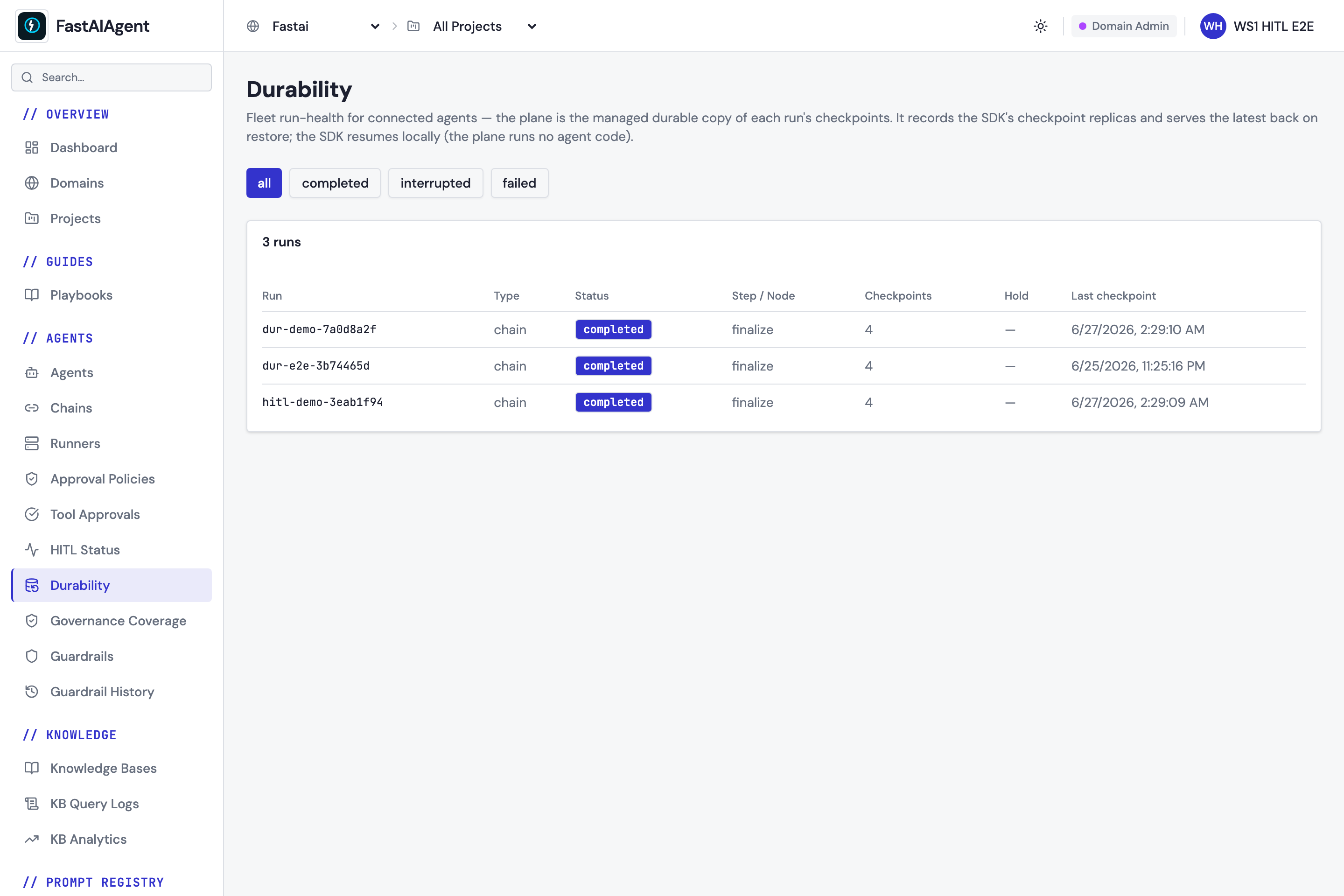
A runnable end-to-end example is in examples/86_connected_durability.py.
One tenant per runner
The drain is process-global, and that bounds what a single process can replicate:
- It runs on a daemon thread and always reads the process-global
connection and project id. A
job_scope()that overrides the project affects the writes, not the drain — the background thread cannot see a per-job ContextVar. safe_get_project_id()returns""rather thanNone, soSQLiteCheckpointer.fetch_unsyncedalways takes its project-scoped branch. A checkpoint written under a different project stamp is therefore never fetched by this process's drain, and sitssynced=0indefinitely.PostgresCheckpointer.fetch_unsyncedignoresproject_identirely — the Postgres schema is not project-scoped. It accepts the argument for protocol parity and drains every un-acked row in the schema.
In practice: run one tenant (one API key, one project) per runner process. Serving several projects from one process will either strand rows the drain never fetches (SQLite) or replicate them all under the connected project (Postgres). Neither is a data-loss bug — local durability is unaffected either way — but neither is what you want from a replica.
Custom checkpointers
Replication uses an optional ReplicatedCheckpointer surface
(fetch_unsynced / mark_synced) — separate from the required Checkpointer
protocol. The built-in SQLite/Postgres backends implement it. A custom
checkpointer that doesn't is fully supported; it simply doesn't replicate (a
no-op, never an error).
Next steps
- Checkpointers — the local backends and their API
- Durability — crash recovery and resume
- Platform Connection —
fa.connect()and the other connected services