Capture any OpenTelemetry / OpenInference framework
FastAIAgent's local trace store already captures every OpenTelemetry span emitted in-process — including spans from third-party instrumentors you didn't write (OpenInference, OpenLLMetry / Traceloop, or your own). The catch is that those instrumentors use different attribute conventions than FastAIAgent's native spans, so out of the box their tokens / cost / model / input / output panels render blank and they get no framework label.
enable_otel_capture() closes that gap with one opt-in call. It is fully
additive — until you call it, nothing changes.
That single call does two things:
- Ordering — adaptively attaches FastAIAgent's storage processor to
whatever global
TracerProvideris active (or claims the slot if none is), so a third-party instrumentor's spans reach the local store regardless of import order. - Display — turns on a write-time normalizer that maps foreign attribute
conventions onto the canonical
gen_ai.*/runner.type/frameworkkeys the Local UI, search index, and cost table read.
End-to-end example (OpenInference + OpenAI)
import fastaiagent as fa
import openai
from openinference.instrumentation.openai import OpenAIInstrumentor

# 1. Turn on a third-party instrumentor on a *non-FastAIAgent* call path.
OpenAIInstrumentor().instrument()

# 2. Opt in to capture + rich rendering.
fa.enable_otel_capture()

# 3. Make a normal OpenAI call — no FastAIAgent agent involved.
client = openai.OpenAI()
client.chat.completions.create(
    model="gpt-4o-mini",
    messages=[{"role": "user", "content": "Summarize the quarterly report."}],
)

# 4. View it in the Local UI — model, tokens, cost, input/output all populated.
#    fastaiagent ui
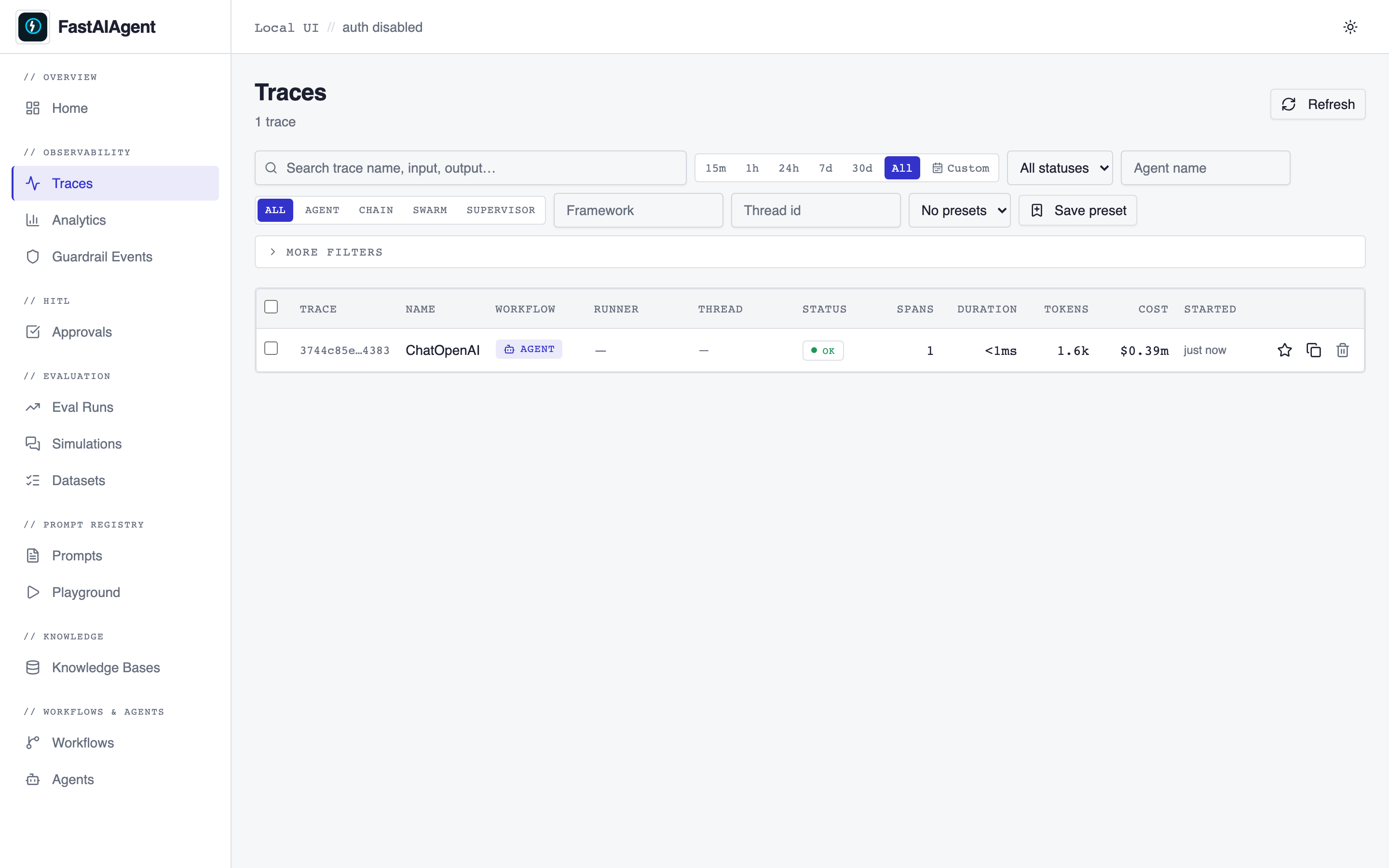
The captured span shows up in the Traces list:
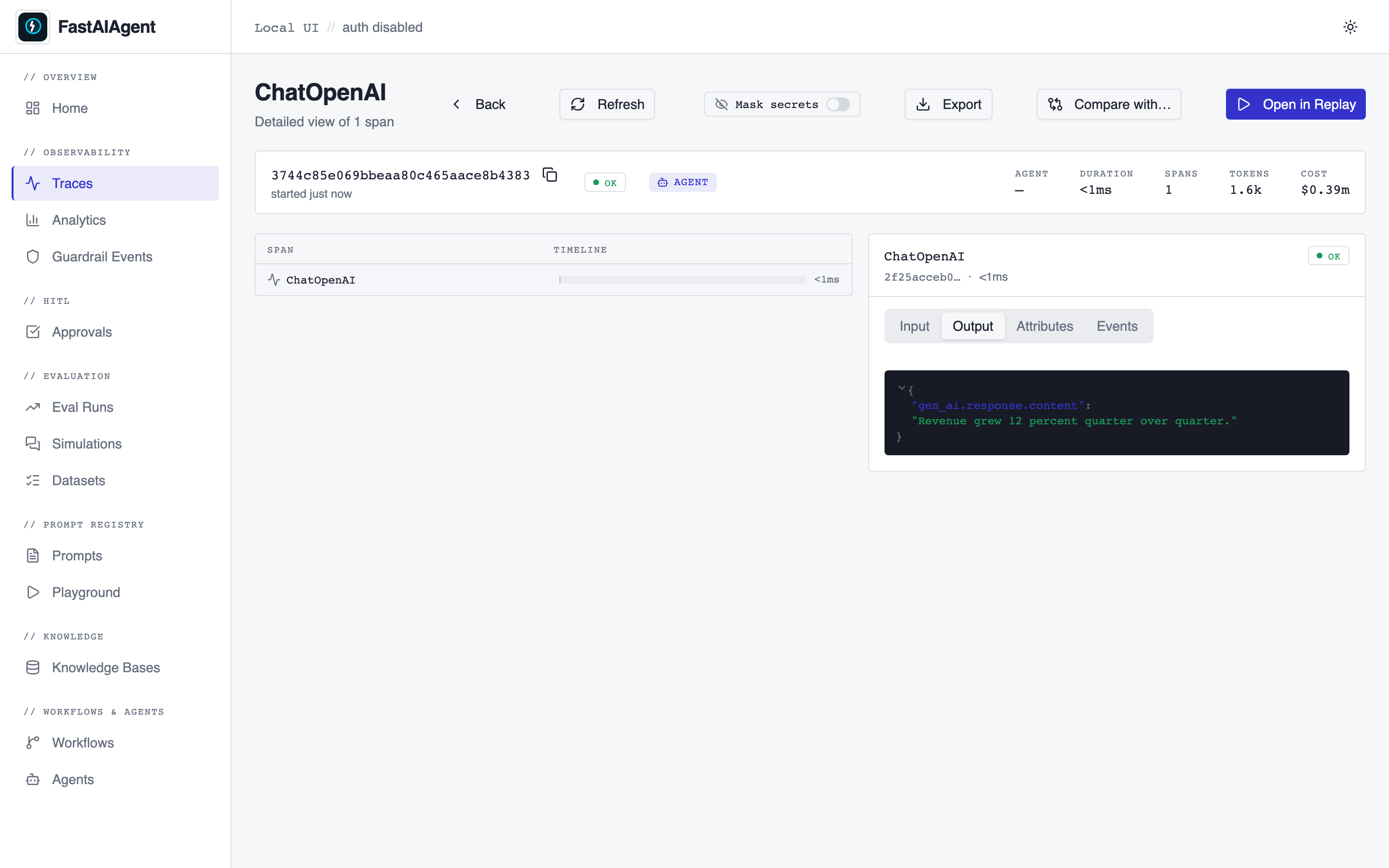
…and on the trace detail page with tokens, cost, and the normalized Input / Output content:
Supported conventions
The normalizer recognizes two convention families and fills the canonical key only when it is absent — originals are always preserved, never overwritten.
| Foreign key (OpenInference / OpenLLMetry) | Canonical key the stack reads |
|---|---|
llm.model_name, llm.request.model |
gen_ai.request.model |
llm.token_count.prompt, gen_ai.usage.prompt_tokens |
gen_ai.usage.input_tokens |
llm.token_count.completion, gen_ai.usage.completion_tokens |
gen_ai.usage.output_tokens |
input.value, gen_ai.prompt.N.content |
gen_ai.prompt and gen_ai.request.messages |
output.value, gen_ai.completion.N.content |
gen_ai.completion and gen_ai.response.content |
openinference.span.kind (LLM/CHAIN/AGENT/TOOL/…) |
fastaiagent.runner.type |
llm.system / llm.provider |
gen_ai.system |
| (derived from model + tokens) | fastaiagent.cost.total_usd, when priceable |
llm.invocation_parameters (JSON) |
gen_ai.request.temperature / max_tokens |
instrumentation scope name (e.g. openinference.instrumentation.openai) |
fastaiagent.framework (root span only) |
Prompt and completion text are written to both the search keys
(gen_ai.prompt / gen_ai.completion, which feed the FTS index) and the UI
panel keys (gen_ai.request.messages / gen_ai.response.content), so a
captured span is both searchable by content and rendered in the
Input/Output tabs.
Cost is computed at capture time, once the model name and token counts have
been normalized, and written as fastaiagent.cost.total_usd — the same key the
SDK's own spans carry.
It was previously left to the Local UI to price these spans when it read them.
That worked locally and nowhere else: a span exported to the FastAIAgent
Platform arrived with tokens and no cost, so the plane priced it from its own
table instead. That table was missing gpt-4.1, and a fuzzy prefix match
charged the 2023 gpt-4 rate — over-reporting 187 live spans by a factor of
10.9. Pricing here means no downstream reader has to guess.
The attribute is set only when the price is known. A model with no rate — a
private fine-tune, a Bedrock or Azure deployment id — leaves it absent rather
than reporting a fabricated 0.0, so a reader can tell "we could not price
this" from "this was free" and fall back to its own estimate. A self-hosted
provider such as Ollama is a known zero and does carry the attribute. A span
that already has a cost keeps it.
Unknown keys pass through untouched and still appear in the span's Attributes tab, so nothing is ever lost.
Call order
enable_otel_capture() is idempotent and robust to import order, but the
cleanest setup is to call it once at startup. If a third-party SDK installs
its own TracerProvider after you call it, just call enable_otel_capture()
again — the second call re-attaches and is a safe no-op otherwise.
fa.enable_otel_capture()        # win or join the active provider
SomeInstrumentor().instrument() # if this swaps the global provider...
fa.enable_otel_capture()        # ...re-attach (idempotent)
Disabling
This stops the normalization (subsequent foreign spans are stored raw again). Note: OpenTelemetry has no API to detach a span processor, so a storage processor previously attached to a foreign provider stays attached — capture continues, only the enrichment stops. Re-enabling later is cheap.
Not a goal (yet)
A network OTLP receiver (an inbound HTTP /v1/traces endpoint for
out-of-process, remote, or polyglot sources) is intentionally out of scope —
enable_otel_capture() covers in-process instrumentors. A network receiver
is tracked as a future / Platform-side capability.
The other direction: your runtime, your exporter
enable_otel_capture() assumes the SDK's exporter is the one exporting — it
pulls foreign spans into FastAIAgent's store. If instead your framework owns
the exporter and you only want to borrow SDK logic (plane-authored guardrails,
platform scorers), don't register a second exporter. Connect with
fa.connect(..., export_traces=False) and emit the standard OpenInference spans
on your own tracer with fa.emit_guardrail(...) / fa.emit_evaluation(...).
One exporter per process, either way. See Guardrails & evals without the runtime.
Related
- Guardrails & evals without the runtime — borrowing SDK primitives when your framework owns the exporter
- Integrations — first-party LangChain / CrewAI / PydanticAI harness + OpenAI / Anthropic SDK auto-tracing
- Tracing — how native spans are captured and stored
- Local UI — the visual trace explorer