Regression from Trace
The canonical pattern for turning a production failure into a passing regression test. Pairs with the Agent Replay API and the new v1.14 fidelity affordances (guarantees).
The full source lives at
examples/regression-from-trace/.
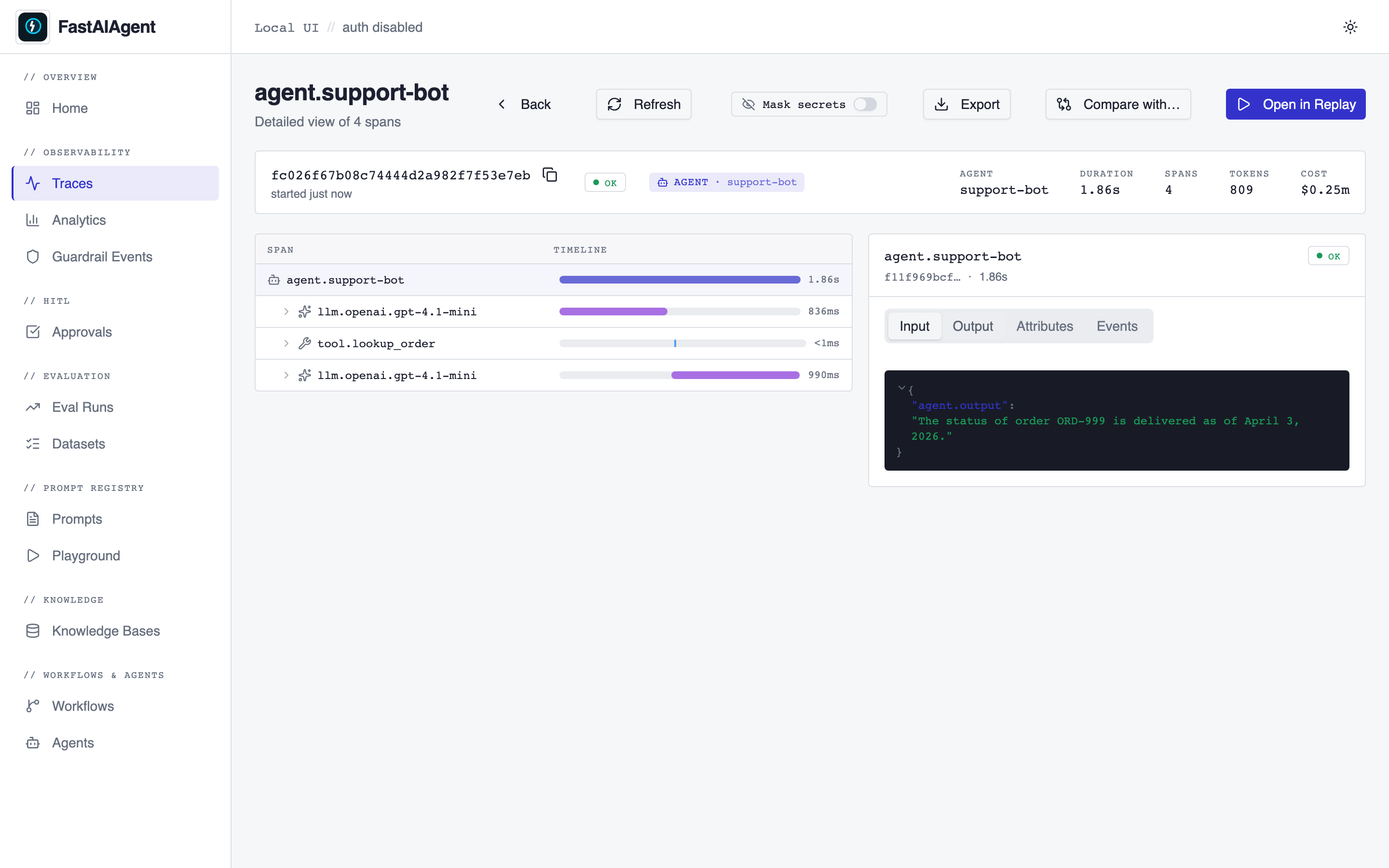
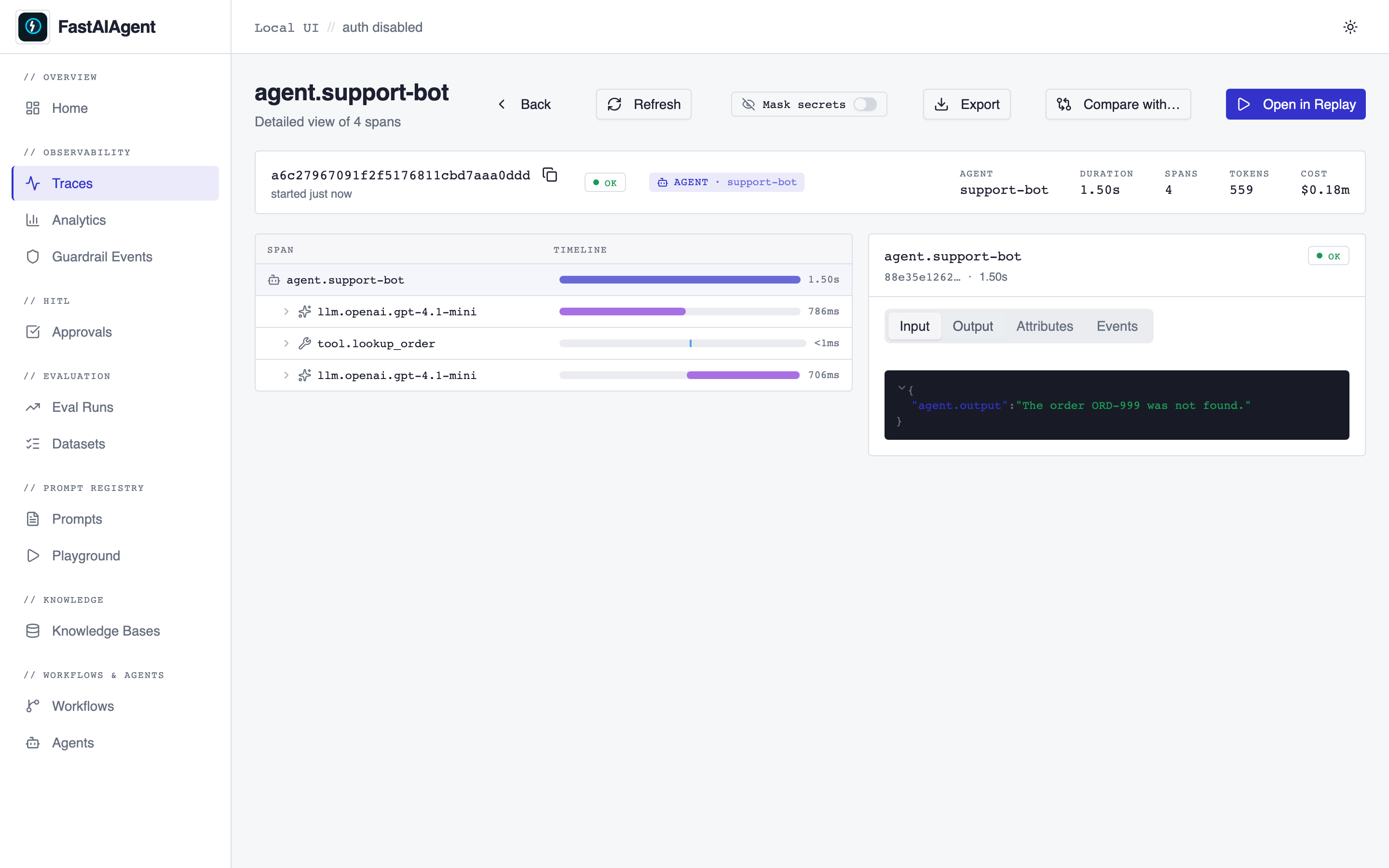
Before / after — same trace shape, fixed output
The buggy lookup_order silently returns ORD-001's record for any
unknown ID (with the requested ID stamped on), so the agent confidently
ships wrong details. After fix.py swaps in the fixed tool and reruns
live, the same prompt and LLM produce the correct "not found" reply.
| Failing trace (buggy tool) | Fixed trace (after with_tool_override) |
|---|---|
 |
 |
The loop
┌──────────────┐    ┌──────────────┐    ┌──────────────┐
│  capture.py  │ ── │  analyze.py  │ ── │   fix.py     │
│  buggy run   │    │  inspect     │    │  fork + fix  │
└──────────────┘    └──────────────┘    └──────────────┘
                                                │
                                                ▼
                          ┌──────────────┐    ┌──────────────┐
                          │  verify.py   │ ── │ save_test.py │
                          │  evaluate()  │    │ append JSONL │
                          └──────────────┘    └──────────────┘
Five small scripts, one shared trace ID stashed in
.fastaiagent-demo/regression-from-trace/last_trace_id.txt. Run them
in order or jump in at any step — each can be invoked standalone
once its input file exists.
The deliberate bug
The template ships with a broken lookup_order tool. It silently
falls back to ORD-001's record when asked about an unknown order ID,
stamping the requested ID onto the fallback data so the LLM has
nothing to cross-check:
def _lookup_order_buggy(order_id: str) -> dict[str, str]:
    found = KNOWN_ORDERS.get(order_id)
    if found is not None:
        return found
    # Silent fallback — overwrite the id so the response looks coherent.
    fallback = dict(KNOWN_ORDERS["ORD-001"])
    fallback["id"] = order_id
    return fallback
A customer asks "What's the status of order ORD-999?" The agent confidently replies "Your order ORD-999 for the MacBook Pro 16-inch has been delivered on 2026-04-03." Nothing crashed, no test would catch it — until a customer complaint surfaces the failure.
This is the silent-failure class. Fail-loud bugs (exceptions, structured errors) get caught by CI; silent ones need the trace → replay loop to find and fix.
The five steps
1. capture.py — reproduce in a trace
agent = build_buggy_agent()
result = agent.run("What's the status of order ORD-999?")
TRACE_ID_FILE.write_text(result.trace_id)
Stashes the trace ID for the rest of the loop to consume.
2. analyze.py — find the smoking gun
replay = Replay.load(trace_id)
for step in replay.step_through():
    print(f"[{step.step}] {step.span_name}")
Walks every span. The tool.lookup_order span shows the fallback
record reaching the LLM.
3. fix.py — fork, override, rerun live
forked = (
    Replay.load(trace_id)
    .fork_at(step=0)
    .with_tool_override("lookup_order", fixed_lookup_order_tool())
)
rerun = forked.rerun()    # live mode — LLM re-ingests corrected tool output
with_tool_override is new in v1.14. It substitutes a single tool by
name while keeping every other tool, prompt, and LLM config from the
original capture. Live rerun mode means the LLM sees the new tool
output and re-generates its reply.
4. save_test.py — append to the regression dataset
result.save_as_test(
    "regression_dataset.jsonl",
    input="What's the status of order ORD-999?",
    expected_output=str(rerun.new_output),
    source_trace_id=original_trace_id,
)
JSONL fields match what fastaiagent.eval.evaluate(...) reads
natively.
5. verify.py — evaluate() against the fixed agent
results = evaluate(
    agent_fn=lambda text: build_fixed_agent().run(text).output,
    dataset="regression_dataset.jsonl",
    scorers=[LLMJudge(criteria="correctness")],
)
LLMJudge (not exact_match) because LLM outputs are paraphrase-stable
but not byte-stable. Every captured failure should pass forever once
the fix is in place.
Why a live rerun, not determinism="recorded"
with_determinism("recorded") skips the LLM HTTP call and replays
the captured response — useful when the prompt is what you're
fixing. For a tool fix, the LLM has to re-ingest the new tool
output and re-generate, so fix.py uses the default "live" mode.
See Fidelity Guarantees for the per-mode
matrix.
What gets caught forever
Every row in regression_dataset.jsonl is one production-failure
class the agent must keep handling correctly. The dataset grows
append-only — when a new customer complaint surfaces, run
capture.py with the new input, fix.py with the new fix,
save_test.py to commit the case. Future verify.py runs catch any
regression of the same failure mode, automatically.
Enforcing it in CI
verify.py proves the fix locally; Agent CI
makes it block a merge. The same JSONL drives a gated pytest run:
@dataset("regression_dataset.jsonl")
def test_no_regressions(eval_case, evaluate_one):
    evaluate_one(agent.run, scorers=[LLMJudge(criteria="correctness")])
Rows written by save_as_test() load through @dataset(...) unchanged,
so the capture → fix → save loop feeds the gate with no glue code.