Replay Fidelity Guarantees
This page documents what Agent Replay captures, what it can faithfully
reproduce, and where the known fidelity gaps are. Each guarantee is
backed by a test in
tests/test_replay_determinism.py.
Determinism modes
ForkedReplay.with_determinism(mode) controls how the LLM is invoked
during a rerun:
| Mode | LLM HTTP call | Output |
|---|---|---|
"live" (default) |
Yes — uses the captured temperature/seed. | Nondeterministic for non-zero temperature. Matches the original behavior. |
"recorded" |
No — replays the captured response. | Byte-identical to the original. Use for regression tests. |
"deterministic" |
Yes — but with temperature=0 and seed=42 forced. |
Semantically stable across runs where the provider supports seed. |
from fastaiagent.trace.replay import Replay

replay = Replay.load(trace_id)
forked = (
    replay
    .fork_at(step=0)
    .modify_prompt("Be more concise.")
    .with_determinism("recorded")  # ← skips the LLM call entirely
)
result = forked.rerun()
What "recorded" mode captures
The recorded LLMResponse is reconstructed from these GenAI
semantic-convention attributes on the captured llm.* span:
gen_ai.response.content— main text outputgen_ai.response.finish_reason—stop,length, etc.gen_ai.response.tool_calls— tool invocations the original LLM requested (JSON-decoded intoToolCallinstances)
If FASTAIAGENT_TRACE_PAYLOADS=0 was set on the original run, none
of these attributes are present and recorded mode raises
ReplayError. The fix is to enable payloads on the runs you intend
to replay later.
A turn that only calls tools is replayed too (1.84.0). OpenAI sends content:
null on such a turn, so its span has gen_ai.response.tool_calls and no
gen_ai.response.content. Before 1.84.0 those spans were skipped. A recorded
rerun of any tool-using agent jumped straight to the captured final answer, never
ran a tool, and still matched the original output. Now the tool-call turn is
served in order, so the rerun really executes the agent's tools. Use
with_tool_override(...) to stub any tool with side effects.
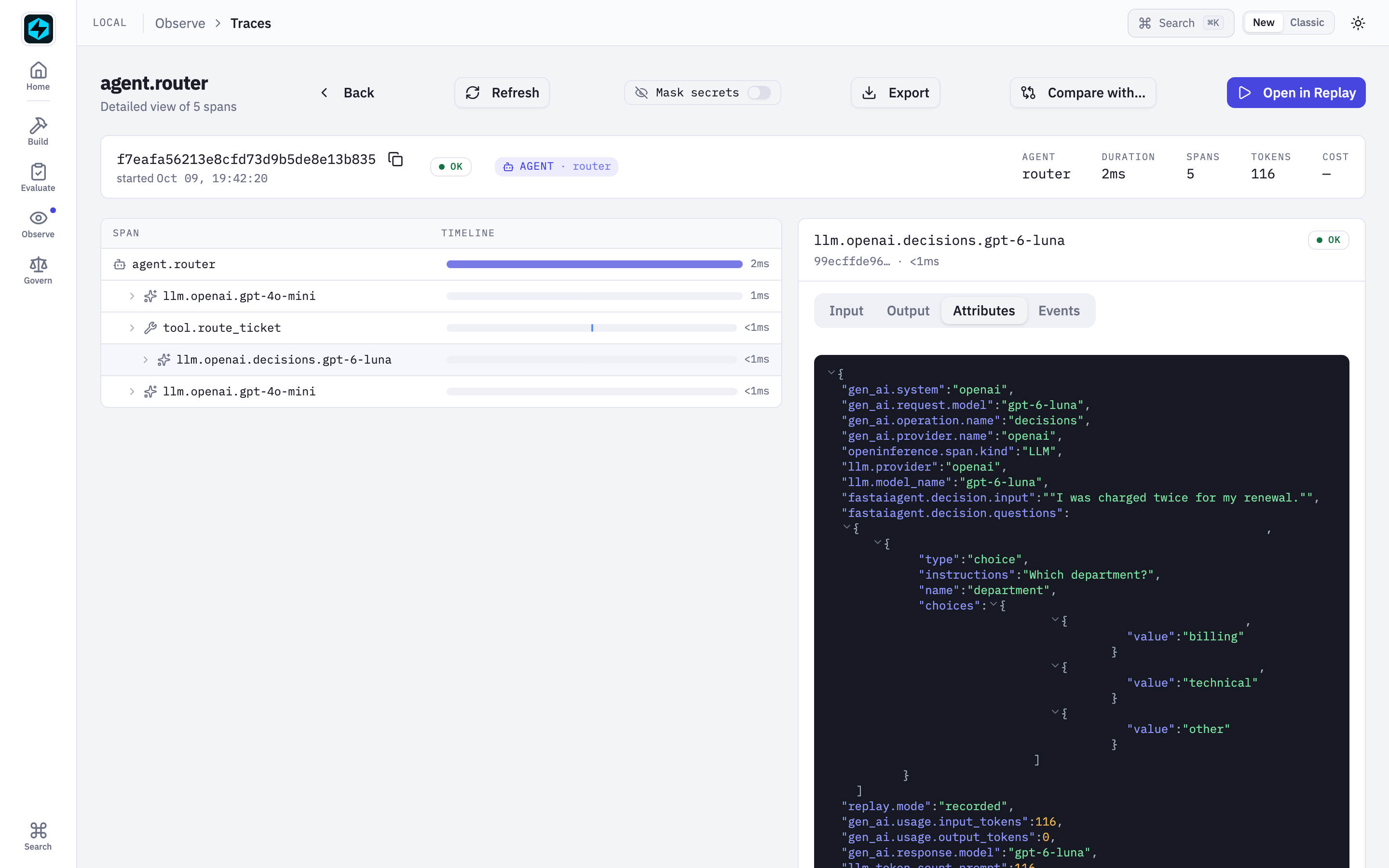
Decisions API calls (1.84.0)
Calls to LLMClient.adecide are recorded on their own
llm.<provider>.decisions.<model> spans (identified by gen_ai.operation.name="decisions"),
and they replay from their own queue. A decision is
never handed to a chat turn, or a chat turn to a decision. Under recorded, each
adecide gets the next captured result, tagged replay.mode="recorded". A
decision the original run didn't make is a miss, handled by on_miss. That
covers more decisions than were captured, or a captured one that answered
different questions.
Multi-turn replay (v1.14.1+)
For a multi-turn tool-loop trace with N captured llm.* spans,
recorded mode installs the full ordered sequence of responses
(sorted by start_time) and pops the front entry for each
LLMClient.acomplete call during rerun. So:
- Turn 1 of the rerun gets the trace's first captured response.
- Turn 2 gets the second, etc.
- If the rerun makes more LLM calls than the original captured (e.g. a tool override that triggers an extra reasoning turn), the queue drains and subsequent calls fall through to a live provider call — the agent doesn't deadlock.
Pre-v1.14.1 the same first response was returned for every LLM call in the rerun, which made tool-loop replays nonsensical (every turn parroted turn 1).
Controlling the drained-queue fall-through (v1.48.0+)
That live fall-through is billed and nondeterministic, and before v1.48.0 it happened silently. It is now warned loudly, and you can make it fatal — recommended whenever the rerun is a regression test:
forked.with_determinism("recorded", on_miss="error")   # raises ReplayError
forked.with_determinism("recorded")                    # default: on_miss="live"
on_miss="error" raises before any provider call, so a recorded suite
can never quietly spend tokens or return drifted output.
Known fidelity gaps
These are documented limitations to set expectations. Each is tracked in the top-3-recommendation as a deferred follow-up.
Streaming chunks aren't recorded granularly
Streaming responses (agent.astream(...)) yield individual
StreamEvent chunks, but only the final accumulated content
lands in gen_ai.response.content. recorded mode reconstructs the
LLMResponse from that final text — streaming cadence is lost.
For most regression-test scenarios this is fine: the final answer is what you're testing. If you need per-chunk fidelity, file an issue — granular streaming capture is on the deferred-follow-up list.
Tool execution is rerun, not recorded
recorded mode skips the LLM call but does not skip tool calls.
If the LLM's recorded response includes a tool invocation, that tool
will execute live during rerun. Two ways to handle this:
with_tool_override(name, stub)— replace a single tool with a deterministic stand-in. Other tools keep their reconstructed implementations. Multiple calls compose.with_tools([...])— full replacement. All tools come from the list you pass; nothing is reconstructed from the trace.
forked.with_tool_override("search_kb", deterministic_stub)
forked.with_tool_override("create_ticket", another_stub)
Pauses and governance during a rerun
The rerun agent is rebuilt from the trace without a checkpointer and without
its platform agent_id. Two consequences:
- A rerun cannot pause. If a tool calls
interrupt(),arerun()raisesReplayErrornaming what it paused on; override that tool withwith_tool_override(...)to replay past it. (Before 1.78.0 the bareInterruptSignalescapedarerun().) - A rerun is not governed. Managed approval policies never gate it. Rebuilt
tools have no function unless you supply one, so a real side-effecting tool
only runs in a rerun when you pass it in through
with_tool_override/with_tools— an explicit, local choice.
Marking tools with replay_class
Rather than override tools by hand on every rerun, declare each tool's
replay-safety class once at definition time. The central Replay engine reads it
(off the fastaiagent.tool.replay_class span attribute) to decide, per call,
whether to re-execute or inject the recorded output:
replay_class |
Replay behavior |
|---|---|
"read_only" |
May be re-executed (no side effects — a GET, a pure lookup). |
"idempotent" |
Recorded output is injected (re-running is safe but unnecessary). |
"side_effecting" |
Recorded output is injected; never re-executed. |
from fastaiagent.tool import tool

@tool(name="search_kb", replay_class="read_only")
def search_kb(query: str) -> str:
    ...

@tool(name="create_ticket")           # unmarked → "side_effecting" (safe default)
def create_ticket(summary: str) -> str:
    ...
The default is "side_effecting", and a value is never auto-inferred — a
GET RESTTool is not automatically read_only. See
Tools → Replay safety.
Provider-specific determinism support
| Provider | temperature=0 |
Seed support |
|---|---|---|
| OpenAI / Azure OpenAI | ✅ | ✅ via seed= |
| Anthropic | ✅ | ✅ via seed= |
| Gemini (native wire) | ✅ | ✅ via seed= |
| Bedrock | ✅ | ❌ — Bedrock has no seed field |
| Ollama / vLLM / local | ✅ | ✅ via seed= |
| Provider presets (groq, openrouter, mistral, …) | ✅ | Varies — most pass through seed= |
deterministic mode degrades gracefully on Bedrock — it forces
temperature=0 and skips the seed. Output is still much more
reproducible than live but not byte-identical across runs.
Divergence detection
forked.compare(result) now computes the first divergence by walking
the original and rerun step lists in parallel. Span names and span
output attributes are compared step-for-step; the first mismatch wins.
This replaces the v1.13 behavior of hardcoding diverged_at to the
fork point — which was misleading because the actual divergence often
happens later than where the user asked to fork.
comp = forked.compare(rerun_result)
assert comp.compare_status == "ok"
if comp.diverged_at is None:
    print("rerun matched the original step-for-step")
else:
    print(f"diverged at step {comp.diverged_at}: "
          f"{comp.original_steps[comp.diverged_at].span_name}")
When the rerun trace can't be loaded (e.g., Agent.arun failed),
compare_status is set to "rerun_failed" and diverged_at stays
None — so UIs can distinguish "matched everything" from "couldn't
tell".
Saving a rerun as a regression test
rerun.save_as_test(...) appends a JSONL line in the format
evaluate() reads natively:
rerun.save_as_test(
    "regression_tests.jsonl",
    input="What is our refund policy?",
    expected_output=str(rerun.new_output),
    source_trace_id=original_trace_id,
)
For the full failure → fix → regression-test loop, see
examples/62_replay_to_regression.py.