Project scoping
The Local UI scopes every read and write by a project_id so multiple
projects can share the same database (e.g. a Postgres backend) without
cross-contamination. The active project is shown in the header
breadcrumb.
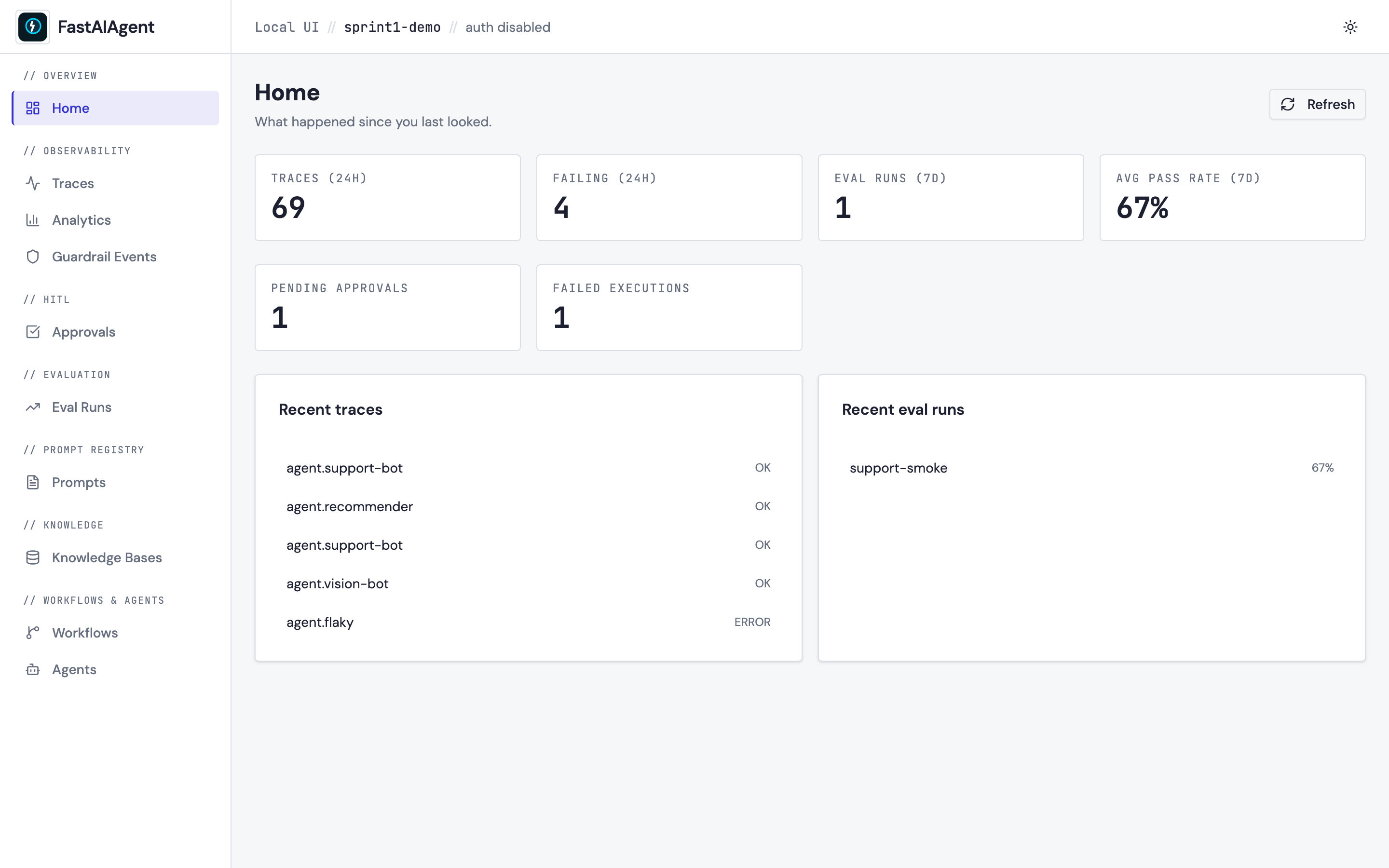
In the screenshot above, the breadcrumb reads
Local UI // sprint1-demo // auth disabled — sprint1-demo is the
project the UI is scoped to. Every trace, agent, workflow, checkpoint,
prompt, eval run, and guardrail event in the visible cards is stamped
with the same project_id.
Lifecycle
The project_id comes from ./.fastaiagent/config.toml. It's created
on first execution (not on import) — running an Agent or a Chain
in a fresh directory creates:
./.fastaiagent/
├── config.toml      # project_id, created_at, sdk_version
├── .gitignore       # ignores local.db so the DB doesn't get committed
└── local.db         # SQLite, the trace + checkpoint store
config.toml looks like:
The project_id defaults to the current directory's name. Edit
config.toml to choose a different one. Multiple project directories
can coexist:
/projects/refund-bot/.fastaiagent/config.toml   → project_id = "refund-bot"
/projects/weather-bot/.fastaiagent/config.toml  → project_id = "weather-bot"
Both can point at the same Postgres backend; each fastaiagent ui
session shows only that project's data.
import fastaiagent is side-effect-free — it never touches the
filesystem. Folder and config creation happen lazily, on the first
SDK call that actually writes a record.
Opt out
To skip local storage entirely:
No spans are written, no .fastaiagent/ directory is created.
What gets stamped
Migration v4 (run automatically on init_local_db) adds
project_id TEXT NOT NULL DEFAULT '' to:
| Table | Stamped by |
|---|---|
spans |
LocalStorageProcessor (every OTel span export) |
checkpoints |
SQLiteCheckpointer.put |
pending_interrupts |
SQLiteCheckpointer.record_interrupt |
idempotency_cache |
SQLiteCheckpointer.put_idempotent |
trace_attachments |
save_attachment() |
prompts / prompt_versions |
LocalStorageBackend.save_prompt |
eval_runs / eval_cases |
EvalResults.save_to_local_db |
guardrail_events |
record_guardrail_event |
Existing rows pre-migration are backfilled with the current
project_id so legacy data carries through.
What gets filtered
Every Local UI read endpoint that surfaces project-owned data
filters by project_id. The list below is exhaustive — a parameterised
leakage test in
tests/e2e/test_project_scoping.py
asserts that none of these reveal another project's data:
- Traces —
GET /api/traces,GET /api/traces/{id},GET /api/traces/{id}/spans,GET /api/traces/{id}/scores,GET /api/traces/{id}/spans/{span_id}/attachments(+ binary stream),GET /api/traces/threads,GET /api/threads/{thread_id},GET /api/traces/compare - Agents —
GET /api/agents,GET /api/agents/{name},GET /api/agents/{name}/tools - Workflows —
GET /api/workflows,GET /api/workflows/{type}/{name} - Analytics —
GET /api/analytics,GET /api/analytics/costs - Overview —
GET /api/overview - Prompts —
GET /api/prompts,GET /api/prompts/{slug},GET /api/prompts/{slug}/versions,GET /api/prompts/{slug}/lineage - Evals —
GET /api/evals,GET /api/evals/{run_id},GET /api/evals/trend,GET /api/evals/compare - Guardrails —
GET /api/guardrails - Executions —
GET /api/pending-interrupts,GET /api/executions/{id},GET /api/executions/{id}/idempotency-cache,POST /api/executions/{id}/resume - KB lineage —
GET /api/kb/{name}/lineage
Per-id endpoints (single trace, single eval run, single prompt, single execution) return 404 for cross-project lookups so a probing caller can't even confirm the resource exists in another project. List endpoints return 200 with no rows belonging to other projects.
When project_id is the empty string the filter is skipped — this is
the legacy / unscoped mode used by tests and pre-v4 databases.
Real users running fastaiagent ui always get the strict filter
because ProjectConfig.get_project_id() resolves a non-empty id.
Multiple projects, one Postgres
Two directories pointing at the same Postgres URL with different
project_id values:
# in /projects/refund-bot
$ fastaiagent ui
# Local UI // refund-bot // auth disabled

# in /projects/weather-bot (separate terminal)
$ fastaiagent ui
# Local UI // weather-bot // auth disabled
Each UI shows only its own data. Traces, checkpoints, and the breadcrumb are all scoped.
For teams that want stricter isolation (separate Postgres schemas,
separate permissions), the existing
PostgresCheckpointer(conn, schema="fastaiagent_refund_bot") option
remains. Project scoping via project_id and schema-level isolation
are complementary, not competing.
Tests
The leakage suite at
tests/e2e/test_project_scoping.py
seeds two projects in one DB and asserts each UI client sees only its
own rows on /api/traces, /api/traces/{id}, and /api/agents. It
also covers:
- the lifecycle (config.toml + .gitignore creation on first call)
import fastaiagentnot touching the filesystemset_project_id()override for tests- the v4 migration adding columns to all 10 project-scoped tables
- backwards-compat unscoped mode
API surface
For programmatic use:
from fastaiagent._internal.project import (
    get_project_id,
    set_project_id,
    load_or_create,
)

# Read the active project
print(get_project_id())   # "my-project"

# Override at runtime (tests use this for isolation)
set_project_id("test-fixture")

# Force the .fastaiagent/ lifecycle
config = load_or_create()
print(config.project_id, config.created_at, config.sdk_version)
Verify it end-to-end
scripts/verify_project_scoping.py
spins up two project directories sharing one SQLite DB, runs a real
Agent.run() in each, then boots two scoped FastAPI servers and
asserts no cross-project string ever appears in the other project's
response. Run it after a fresh checkout:
python scripts/verify_project_scoping.py
# ✅ ALL VERIFICATIONS PASSED — project scoping holds end-to-end.
The script is the canonical "does this actually work?" demo and runs against the real SDK + real FastAPI + real SQLite (no mocks).